Can ChatGPT Help You Improve IELTS Speaking? A Practical Guide for IELTS Candidates
Category: IELTS Preparation
Primary keyword: ChatGPT for IELTS Speaking
Secondary keywords: IELTS Speaking practice, IELTS Speaking Band 7, AI IELTS preparation, IELTS Speaking fluency
Suggested URL: "/blogs/can-chatgpt-help-improve-ielts-speaking"
Introduction
Preparing for IELTS Speaking is not simply about learning English vocabulary or memorising impressive answers. You need to express ideas clearly, speak naturally, organise your thoughts and respond confidently to unfamiliar questions.
Today, AI tools such as ChatGPT offer new opportunities for independent speaking practice. But can AI really help you improve your IELTS Speaking score?
Let's explore this through practical questions and answers.
Q1. Can ChatGPT help me prepare for IELTS Speaking?
Yes. ChatGPT can act as a practice partner and help you develop several important speaking skills.
You can use it to:
- Practise IELTS Speaking Part 1, Part 2 and Part 3.
- Generate topic-related questions.
- Develop ideas for unfamiliar topics.
- Practise giving longer and more meaningful answers.
- Identify grammatical mistakes.
- Improve vocabulary and sentence construction.
However, practising with AI is not the same as receiving an official IELTS assessment.
Q2. How can I use ChatGPT to practise IELTS Speaking Part 1?
Part 1 requires you to answer familiar questions about your life, interests, work, studies and everyday experiences.
Instead of memorising answers, practise responding naturally.
For example:
Question: Do you enjoy reading books?
Basic answer:
Yes, I like reading books because they are interesting and informative.
Improved answer:
Yes, I enjoy reading, particularly books about personal development and communication. I find that reading regularly helps me learn new ideas and look at everyday situations from different perspectives.
The second answer provides more meaningful information without sounding unnecessarily complicated.
Q3. Can ChatGPT help me improve IELTS Speaking Part 2?
Absolutely.
Part 2 requires you to speak for up to two minutes on a given topic after one minute of preparation.
You can ask ChatGPT to provide cue cards and help you organise your responses.
Try this prompt:
"Give me an IELTS Speaking Part 2 cue card. Allow me to prepare my response for one minute and then practise speaking for two minutes. Evaluate my response for fluency, vocabulary, grammar and coherence."
The important point is to practise speaking independently rather than simply reading AI-generated answers.
Q4. How can AI help me improve IELTS Speaking Part 3?
Part 3 requires more analytical thinking.
You may be asked to discuss social changes, education, technology, environmental issues and future developments.
For example:
Question: Do you think technology has improved communication?
A weak response might simply say that technology makes communication easier.
A stronger response would explain how technology has improved accessibility, enabled international communication and changed professional relationships.
Ask ChatGPT to give you follow-up questions that challenge your opinions and encourage you to explain your reasoning.
Q5. Can ChatGPT help me achieve Band 7 in IELTS Speaking?
It can support your preparation, but it cannot guarantee Band 7.
To reach Band 7, candidates need to demonstrate:
- Sufficient fluency and coherence.
- Flexible vocabulary.
- A range of grammatical structures.
- Good grammatical control.
- Clear and understandable pronunciation.
Simply using advanced vocabulary does not guarantee a higher score.
Your answers must communicate ideas effectively and naturally.
Q6. Should I memorise ChatGPT-generated IELTS answers?
No. Memorising complete answers is not a reliable preparation strategy.
Examiners are interested in your ability to communicate spontaneously.
Instead, use AI-generated answers to understand:
- How to develop an idea.
- How to provide relevant examples.
- How to explain opinions.
- How to connect different points.
- How to use vocabulary appropriately.
Learn the technique, not the complete answer.
Q7. Can ChatGPT evaluate my pronunciation?
ChatGPT's voice features can help you practise spoken English and receive feedback on aspects of your communication.
However, automated feedback should not be treated as an official IELTS pronunciation score.
Pay attention to:
- Word stress.
- Sentence stress.
- Intonation.
- Individual sound clarity.
- Natural speech rhythm.
Recording yourself and listening critically can also help identify recurring problems.
Q8. What is the biggest mistake students make when using AI for IELTS Speaking?
The biggest mistake is allowing AI to do all the thinking.
Students frequently ask AI to generate impressive answers and then attempt to reproduce them.
This creates dependency rather than communication ability.
IELTS candidates should develop their own ideas, organise their thoughts and express them in their own words.
This is where a structured learning approach becomes important.
Q9. How does the Salkade Communication Framework™ help IELTS candidates?
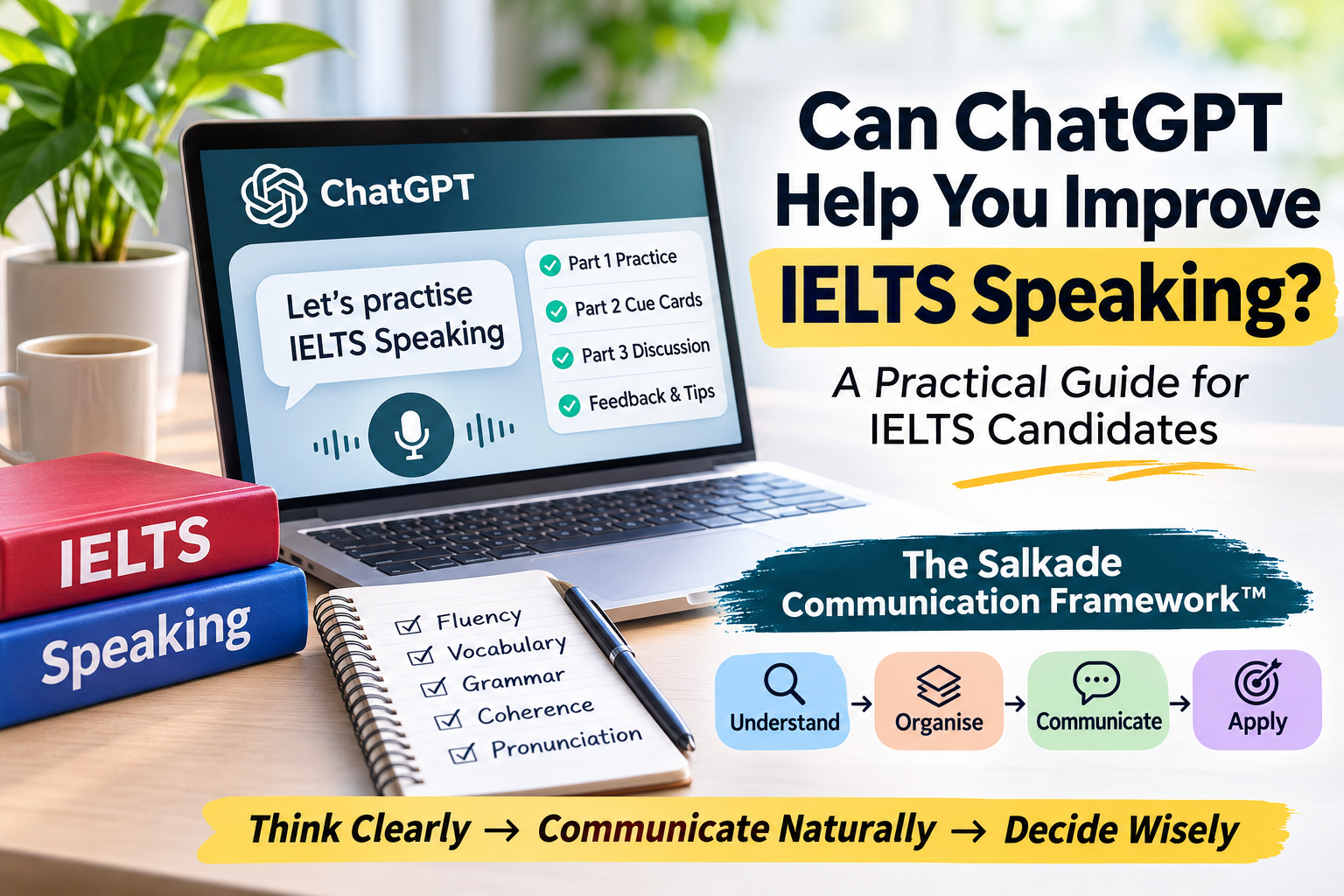
The Salkade Communication Framework™ follows the philosophy:
Think Clearly → Communicate Naturally → Decide Wisely
Its practical learning process is:
1. Understand: Understand the question and identify what it requires.
2. Organise: Arrange your ideas logically before responding.
3. Communicate: Express your thoughts naturally and clearly.
4. Apply: Use the skill independently in unfamiliar speaking situations.
This approach encourages candidates to become independent communicators instead of memorising model answers.
Q10. What is the best daily routine for practising IELTS Speaking with ChatGPT?
A simple 30-minute routine can make your preparation more structured.
Activity| Time
Part 1 question practice| 5 minutes
Part 2 cue card practice| 8 minutes
Part 3 analytical questions| 10 minutes
Review mistakes and vocabulary| 7 minutes
Practise regularly and maintain a record of recurring mistakes.
Remember that consistency and meaningful practice matter more than the number of questions you complete.
Final Thoughts
ChatGPT can make IELTS Speaking practice more accessible, interactive and flexible. But technology alone cannot develop effective communication skills.
Candidates must learn to think independently, organise ideas and express themselves naturally.
The objective should not be to sound like AI. It should be to become a confident English communicator.
Think Clearly. Communicate Naturally. Decide Wisely.
---
About the Author
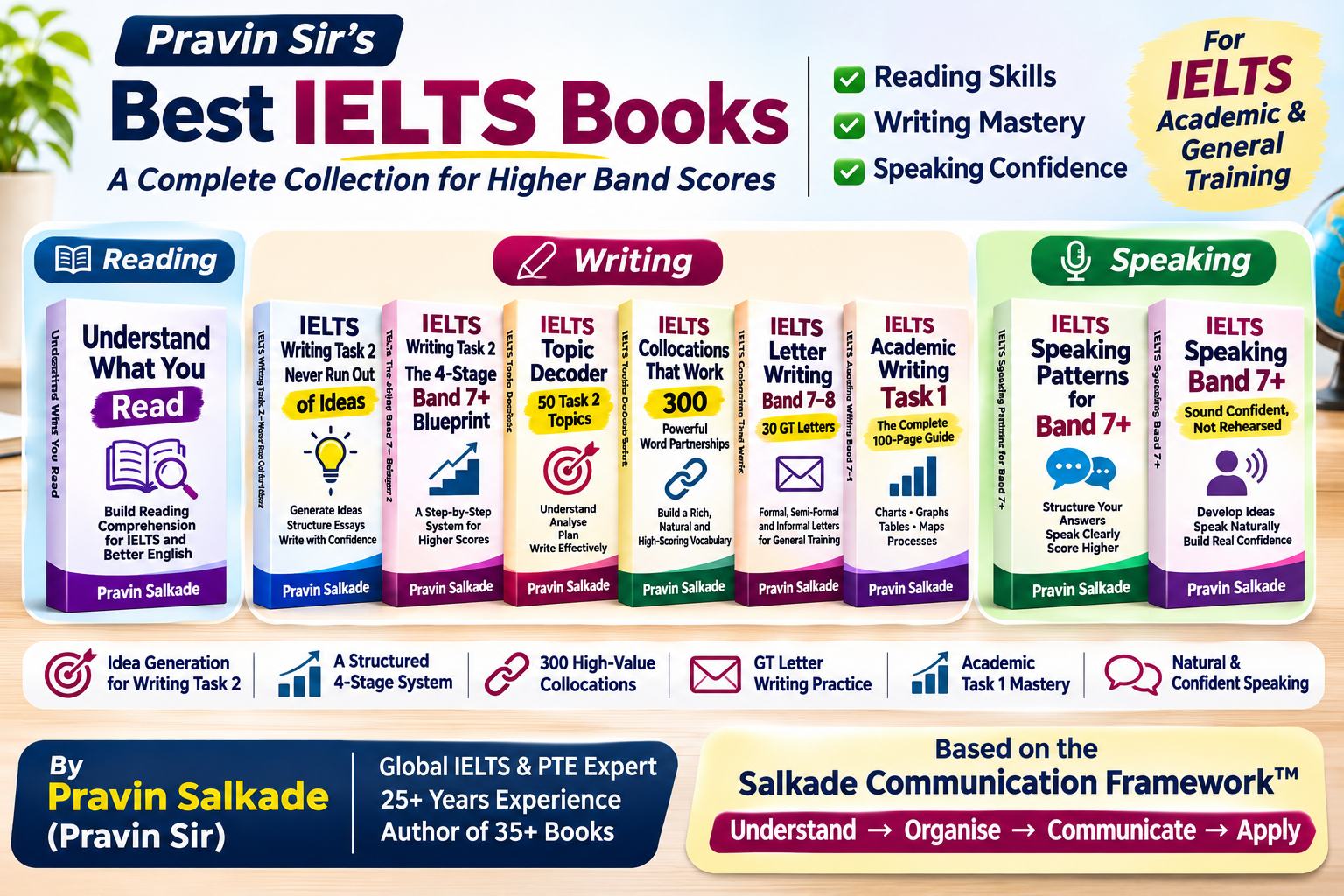
Pravin Salkade (Pravin Sir) is an English language educator, IELTS and PTE expert, and author of 35+ published books. With over 25 years of experience, he focuses on practical communication, examination strategies and independent learning through the Salkade Communication Framework™.
Explore more learning resources:
https://www.pravinsalkade.com/blogs
Suggested reader action: Explore IELTS preparation resources and discover practical ways to improve your English communication skills.