How Can You Improve Both PTE Reading and Writing Skills? A Complete Preparation Guide
By Pravin Salkade | Global IELTS & PTE Expert
The Salkade Communication Framework™
Introduction
PTE Reading and Writing require candidates to understand written information, recognise grammatical structures, interpret meaning and communicate ideas accurately.
Many candidates prepare for individual question types without understanding how reading and writing skills complement each other.
Strong reading improves vocabulary, grammar awareness and comprehension. Strong writing develops the ability to organise ideas and communicate them clearly.
Let's explore how to prepare for both skills systematically.
Q1. Why do students struggle with PTE Reading and Writing?
Common difficulties include:
- Limited vocabulary.
- Weak understanding of collocations.
- Grammatical errors.
- Difficulty identifying the main idea.
- Poor sentence construction.
- Inadequate time management.
- Excessive dependence on memorised strategies.
These weaknesses are interconnected.
For example, a candidate who struggles to understand sentence structure may also struggle to construct accurate written responses.
Q2. How can I improve my PTE Reading skills?
Reading improvement requires more than reading quickly.
Develop the following skills:
Vocabulary: Learn words in context and understand their usage.
Grammar: Recognise sentence structures and grammatical relationships.
Comprehension: Identify the main idea, supporting details and relationships between sentences.
Logical reading: Understand contrast, comparison, cause and effect, and examples.
Practice: Solve different question types and analyse every incorrect answer.
Regular reading of well-structured English passages can also improve familiarity with natural language.
Q3. How can I improve my PTE Writing skills?
Start by developing sentence accuracy.
Work on:
- Subject-verb agreement.
- Articles and prepositions.
- Appropriate vocabulary.
- Sentence variety.
- Logical organisation.
- Clear expression of ideas.
Practise writing responses within the prescribed time.
Review your work and identify repeated errors rather than simply writing more essays.
Q4. How are reading and writing skills connected?
Reading provides exposure to vocabulary, grammar, sentence patterns and logical organisation.
Writing requires you to apply these skills independently.
For instance, reading a well-structured argumentative passage can help you understand how an author introduces a position, supports it with evidence and develops a conclusion.
You can then apply these principles when writing your own responses.
Q5. Is vocabulary more important than grammar in PTE?
Neither should be considered independently.
Vocabulary helps you express meaning precisely, while grammar helps you organise words into meaningful sentences.
Consider this example:
Incorrect: The students was interested in learning.
Correct: The students were interested in learning.
Knowing the word "interested" is not enough. You must also understand how the sentence works grammatically.
The goal should be balanced language development.
Q6. How should I prepare for different PTE Reading and Writing question types?
Avoid using the same approach for every question.
Understand what each task requires.
For reading, practise identifying:
- Appropriate words in context.
- Missing information.
- Relationships between paragraphs.
- Sentence meaning.
- Logical progression.
For writing, practise:
- Summarising information.
- Developing relevant arguments.
- Constructing accurate sentences.
- Organising ideas.
- Reviewing written responses.
A question-type-specific approach makes preparation more focused.
Q7. How can I avoid depending too much on templates?
Understand the underlying language skills before adopting any fixed structure.
Templates may help organise a response, but they cannot replace comprehension, vocabulary knowledge or grammatical accuracy.
Learn flexible response structures and adapt them to the question.
The ultimate objective is to develop the ability to produce relevant and accurate language independently.
Q8. How can I create an effective PTE preparation routine?
Divide your preparation into four activities:
1. Concept learning: Understand the requirements of each question type.
2. Targeted practice: Work on specific weaknesses.
3. Error analysis: Identify why answers are incorrect.
4. Timed practice: Develop exam readiness.
Keep a record of recurring errors.
This helps you measure improvement more meaningfully than counting the number of questions attempted.
Q9. Which book can help me prepare for PTE Reading and Writing together?
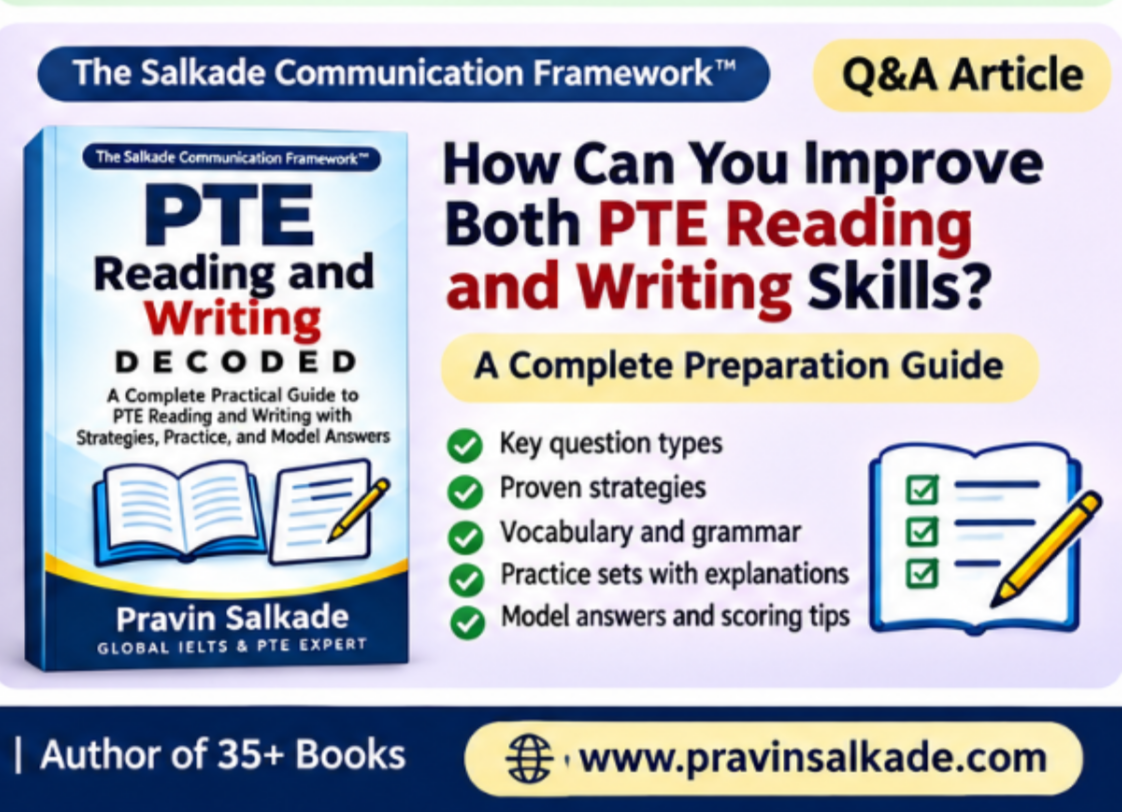
PTE Reading and Writing Decoded – The Salkade Communication Framework™ is a comprehensive practical guide covering PTE Reading and Writing.
It provides:
- Key question types.
- Proven strategies and techniques.
- Practice sets with explanations.
- Model answers.
- Scoring tips.
It is particularly useful for candidates who want a structured understanding of both skill areas.
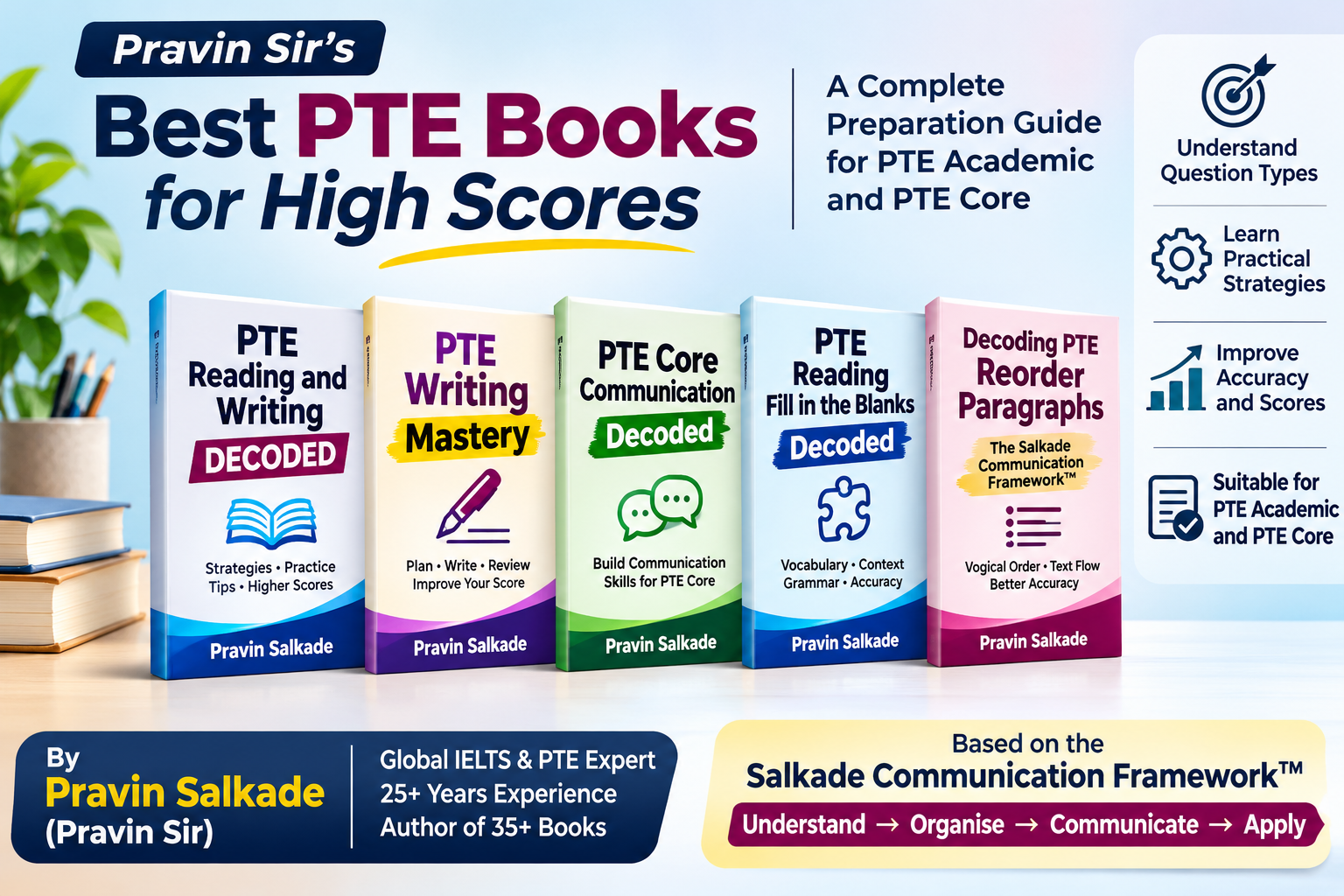
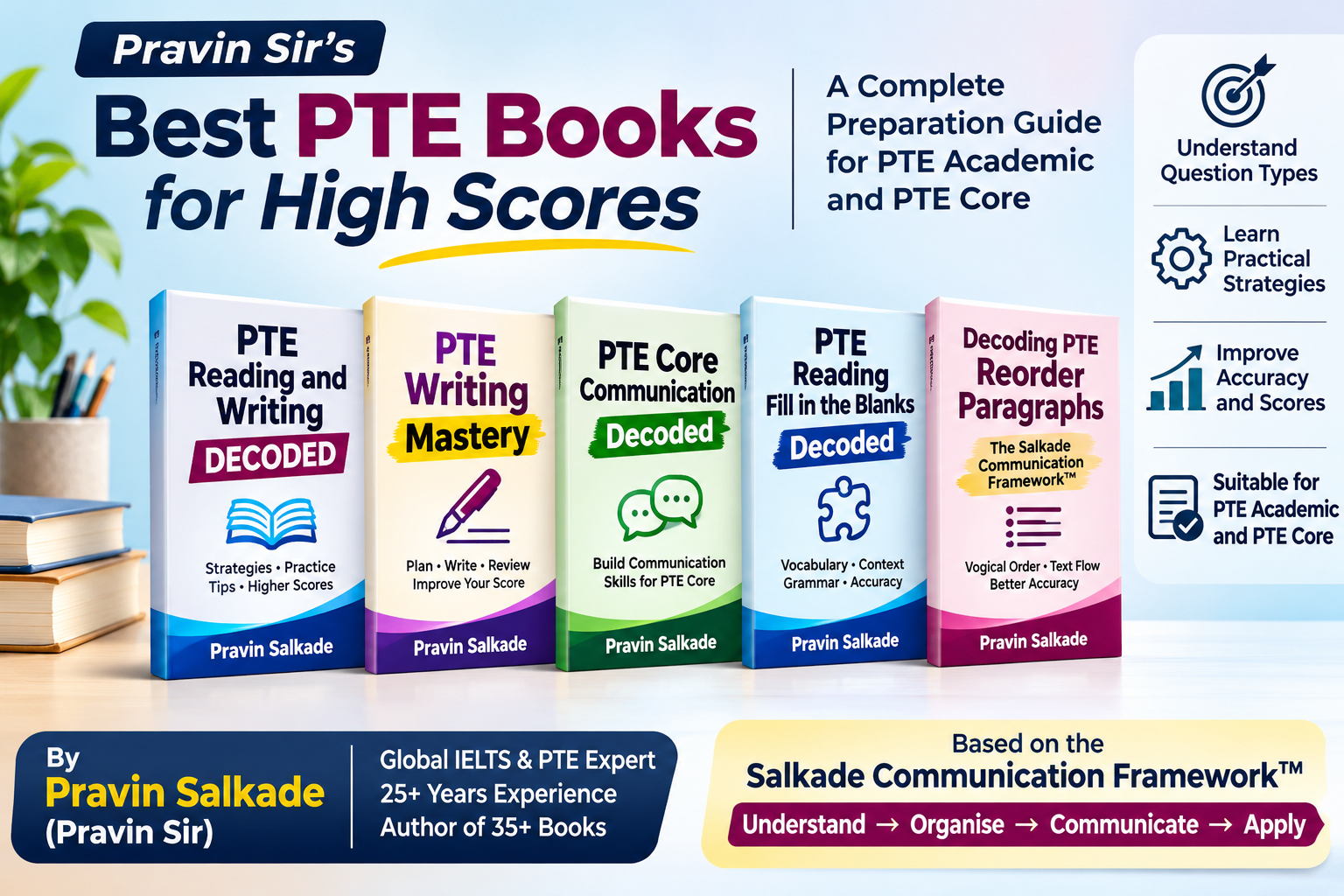
The book complements the more specialised guides in the PTE Complete Series.
Final Thoughts
PTE Reading and Writing should not be treated as disconnected abilities.
Developing vocabulary, grammar, comprehension and sentence construction together can make your preparation more effective.
Learn the concepts, practise strategically and analyse your mistakes.
About the Author
Pravin Salkade is a Global IELTS & PTE Expert and author of 35+ books under the Salkade Communication Framework™.
His books focus on practical strategies, structured learning and independent skill development.
Explore the book: PTE Reading and Writing Decoded, available on Google Play Books.
For personalised PTE preparation, visit www.pravinsalkade.com.