The Salkade AI Series: How Can Students, Professionals and Entrepreneurs Use Artificial Intelligence Intelligently?
A Practical Question-and-Answer Guide to Learning, Working and Creating Opportunities with AI
Artificial Intelligence is changing education, employment, business and everyday life. Students are using AI for learning, professionals are exploring productivity tools, and entrepreneurs are looking for new opportunities.
But an important question deserves attention:
Are we becoming smarter by using AI, or are we becoming dependent on it?
The real value of artificial intelligence lies not simply in generating answers but in improving how people learn, think, communicate and solve problems.
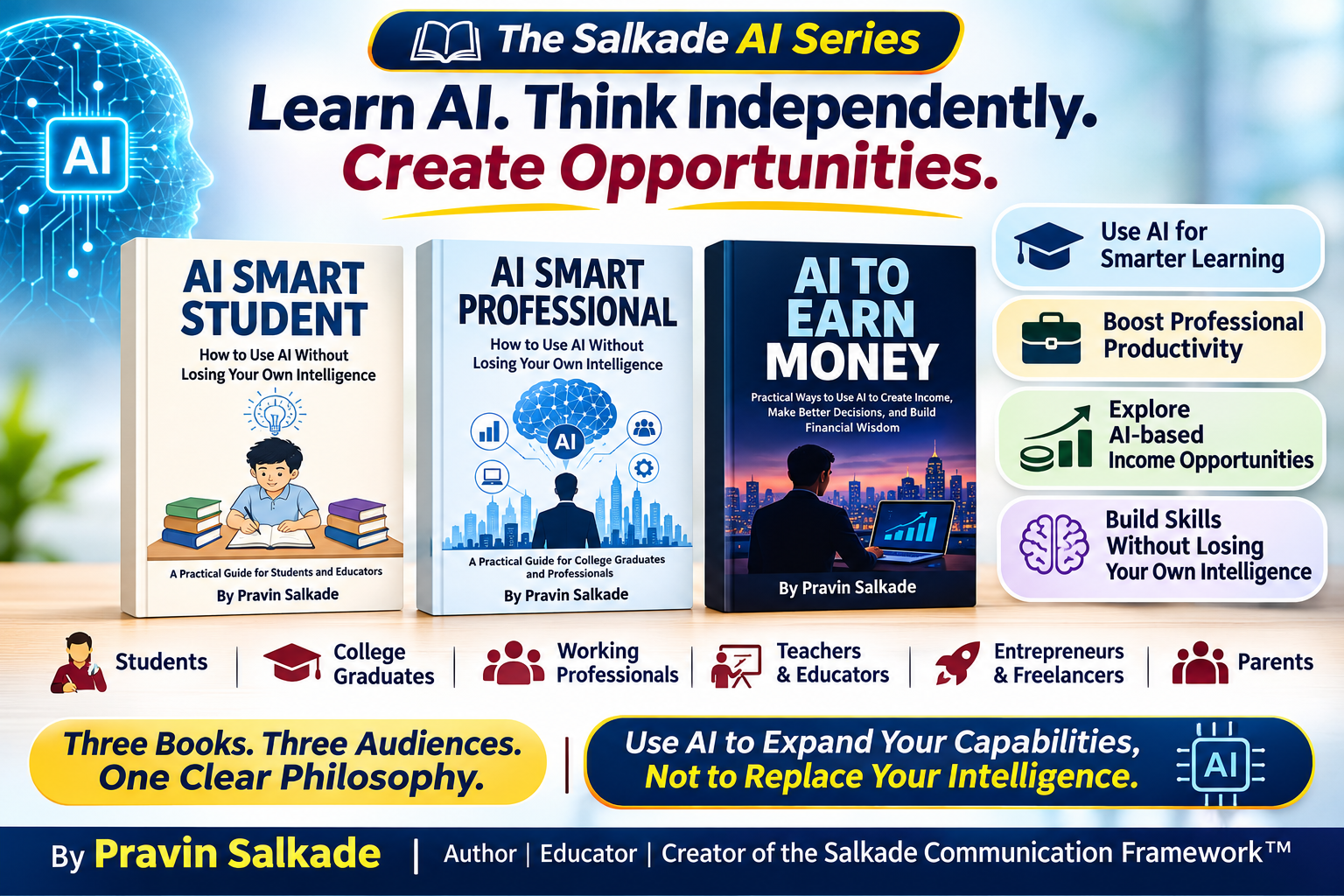
The Salkade AI Series by Pravin Salkade explores three important dimensions of this transformation through three practical books:
1. AI Smart Student – How to Use AI Without Losing Your Own Intelligence
2. AI Smart Professional – How to Use AI Without Losing Your Own Intelligence
3. AI to Earn Money
Here are some important questions about using AI intelligently and how these books can help readers explore its possibilities.
Q1. Why should students, professionals and entrepreneurs learn to use AI?
AI is becoming an important part of modern education and professional life.
Students can use it to understand concepts and practise skills. Professionals can explore ways to improve productivity. Entrepreneurs can investigate new services and business opportunities.
Learning to use AI can help people:
- Access information more efficiently.
- Explore different approaches to problems.
- Improve communication and content development.
- Organise information and ideas.
- Automate certain repetitive tasks.
- Explore new professional possibilities.
However, using AI effectively requires judgment, critical thinking and the ability to evaluate its outputs.
Q2. Can AI make students less intelligent?
AI itself does not necessarily reduce intelligence. The way students use it matters.
Consider two students.
The first student asks AI to complete every assignment and copies the answers.
The second student attempts the assignment independently, asks AI to explain difficult concepts, compares different answers and improves the work.
Both use AI, but their learning experiences are very different.
The second student remains intellectually involved.
Students should use AI to support learning rather than avoid learning.
This is the central idea behind AI Smart Student.
Q3. How can students use AI without losing their own intelligence?
Students should use AI as a learning assistant rather than a replacement for independent thinking.
Practical applications include:
- Asking AI to explain difficult topics.
- Generating practice questions.
- Receiving feedback on written work.
- Exploring alternative explanations.
- Developing vocabulary.
- Creating revision plans.
- Testing their understanding through questions.
An effective approach is to attempt a problem first, use AI to identify gaps and then solve it independently.
This encourages active learning rather than passive copying.
Q4. What is AI Smart Student about?
AI Smart Student – How to Use AI Without Losing Your Own Intelligence is designed for students and educators interested in using artificial intelligence responsibly and productively.
It addresses an important educational challenge: how to benefit from AI while continuing to develop independent thinking and learning abilities.
The book is relevant to:
- School students.
- College students.
- Parents.
- Teachers.
- Academic coordinators.
- Educational institutions.
Its central message is that technology should strengthen the learner, not replace the learner's intellectual effort.
Q5. How can teachers and parents guide students in using AI?
Teachers and parents have an important role in developing responsible AI habits.
They can encourage students to:
1. Attempt questions independently.
2. Use AI to clarify difficult concepts.
3. Verify important information.
4. Identify errors in AI-generated answers.
5. Explain their reasoning.
6. Present their own conclusions.
Schools can also introduce discussions about AI ethics, originality, privacy and responsible technology use.
The objective should be to develop students who can think independently while using modern technology effectively.
Q6. How can working professionals benefit from AI?
AI can support professionals across different industries.
For example:
- Teachers can explore lesson-planning assistance.
- Managers can organise information and prepare reports.
- Marketing professionals can develop content ideas.
- Researchers can explore information and summarise material.
- Entrepreneurs can investigate business opportunities.
- Administrative professionals can streamline repetitive tasks.
However, professionals remain responsible for verifying information and making appropriate decisions.
AI can improve efficiency, but professional judgment remains essential.
Q7. What is AI Smart Professional about?
AI Smart Professional – How to Use AI Without Losing Your Own Intelligence focuses on the relationship between AI capabilities and human professional skills.
The book is relevant to people who want to explore AI applications in their working lives without becoming dependent on generated answers.
It is particularly relevant to:
- Working professionals.
- College graduates.
- Managers and team leaders.
- Teachers and trainers.
- Freelancers.
- Entrepreneurs.
- People preparing for changing workplace requirements.
The underlying principle is that AI should enhance professional capabilities while humans retain responsibility for decisions, quality and outcomes.
Q8. Can AI help college graduates become more employable?
AI familiarity can complement a graduate's existing qualifications and professional skills.
Graduates can explore AI for:
- Research and information organisation.
- Communication practice.
- Presentation preparation.
- Productivity improvement.
- Content development.
- Learning new tools.
- Exploring industry applications.
However, employability also depends on communication, domain knowledge, practical experience and problem-solving ability.
Knowing how to use AI is useful, but knowing how to apply it to real workplace problems is even more valuable.
Q9. Can people earn money using AI?
AI can help people explore income-generating activities, but it does not guarantee income.
Some possible areas include:
- Freelance content services.
- Digital marketing support.
- Educational material development.
- Research assistance.
- Business productivity services.
- Digital product creation.
- Creative services.
- AI-assisted business operations.
Success depends on identifying genuine customer needs, developing useful skills, delivering quality work and finding paying customers.
AI is a tool. A sustainable business still requires a valuable offering and a viable market.
Q10. What is AI to Earn Money about?
AI to Earn Money explores the practical relationship between artificial intelligence and income opportunities.
The book is relevant to people who want to investigate how AI tools can support business activities, productivity and potential income-generating services.
Its intended audience includes:
- College students.
- Young graduates.
- Freelancers.
- Entrepreneurs.
- Working professionals.
- Content creators.
- People exploring additional income opportunities.
Readers should approach AI-based income opportunities realistically. No AI tool or book can guarantee profits or financial success.
Q11. Can people without a technical background use AI?
Yes. Many AI applications are accessible to people without programming knowledge.
Teachers, writers, students, administrators, business owners and professionals can explore AI tools according to their needs.
For example:
A teacher can use AI to develop practice questions.
A writer can explore editing and research assistance.
A business owner can investigate marketing ideas.
A student can explore alternative explanations of difficult concepts.
The most important starting point is understanding the problem one wants to solve.
Q12. What is the difference between using AI and using AI intelligently?
There is a significant difference.
Using AI mechanically| Using AI intelligently
Copying answers| Evaluating answers
Accepting every output| Verifying important information
Avoiding independent effort| Developing independent thinking
Asking vague questions| Asking meaningful questions
Depending on AI for decisions| Retaining human judgment
Using tools without purpose| Applying tools to real problems
Intelligent AI use involves questioning, evaluating, adapting and applying information.
Q13. Can AI replace teachers and professionals?
AI can automate or assist with certain tasks, but it does not eliminate the importance of human expertise.
Teachers provide guidance, motivation, feedback and an understanding of individual learners.
Professionals exercise judgment, understand organisational context and take responsibility for decisions.
Entrepreneurs understand customers, manage uncertainty and build relationships.
AI can support these activities, but human responsibility remains important.
The better question is not whether AI will replace every professional, but how professionals can adapt and use AI effectively.
Q14. Why should students and professionals develop critical thinking alongside AI skills?
AI-generated information is not always accurate.
Users need to recognise errors, question assumptions and verify important claims.
Critical thinking becomes especially important when AI is used for research, financial decisions, business planning, education and professional communication.
People who combine AI familiarity with independent thinking are better positioned to evaluate the usefulness and limitations of technology.
This is why the Salkade AI Series emphasises retaining human intelligence while exploring AI capabilities.
Q15. How are the three books in the Salkade AI Series connected?
The three books address different stages of personal and professional development.
Book| Primary audience| Main focus
AI Smart Student| Students and educators| Learning intelligently with AI
AI Smart Professional| Professionals and graduates| Applying AI in professional life
AI to Earn Money| Entrepreneurs and aspiring earners| Exploring AI-based income opportunities
Together, they address three important questions:
- How can I learn with AI?
- How can I work with AI?
- How can I explore opportunities using AI?
Q16. Who should explore the complete Salkade AI Series?
The collection is particularly relevant to:
- School and college students.
- Parents and educators.
- College graduates.
- Working professionals.
- Teachers and trainers.
- Freelancers.
- Entrepreneurs.
- Content creators.
- People interested in AI and personal development.
Readers can explore the individual titles according to their interests or consider the complete three-book collection.
Q17. Where can readers find the Salkade AI Series?
All three books are available on Google Play Books.
The collection includes:
1. AI Smart Student.
2. AI Smart Professional.
3. AI to Earn Money.
Search for the individual titles and author name, Pravin Salkade, on Google Play Books to explore the books and their current availability.
Final Question: Will AI Make Us Smarter, or Will We Become Dependent on It?
The answer depends largely on how we choose to use it.
If we allow AI to do all our thinking, we risk losing valuable opportunities to develop our own abilities.
If we use it to question, explore, learn, evaluate and create, it can become a powerful tool for personal and professional development.
Students should learn without surrendering their intelligence.
Professionals should improve productivity without surrendering judgment.
Entrepreneurs should explore opportunities without assuming that technology guarantees success.
The Salkade AI Series brings these three perspectives together.
AI Smart Student. AI Smart Professional. AI to Earn Money.
Three books. Three audiences. One central philosophy:
Use AI to expand your capabilities, not to replace your intelligence.
About the Author
Pravin Salkade
Author | Educator | Creator of the Salkade Communication Framework™
Explore more educational articles and resources:
https://www.pravinsalkade.com/articles
Think Clearly → Communicate Naturally → Decide Wisely.