Best Critical Thinking Books by Pravin Sir: Think Clearly, Make Better Decisions and Develop Independent Thinking
Do you react too quickly? Do you accept the first explanation you hear? Do you sometimes take the easiest option without examining the consequences?
In today's information-driven world, critical thinking is no longer an optional skill. It is essential for making informed decisions, solving problems, negotiating effectively and avoiding common judgement errors.
Pravin Sir's critical thinking book collection focuses on developing independent thinking, logical reasoning, practical problem-solving and better decision-making.
Pravin Salkade, popularly known as Pravin Sir, is an educator, author of 35+ books and creator of the Salkade Communication Framework™.
His philosophy is:
Think Clearly → Communicate Naturally → Decide Wisely.
Q1. Who is Pravin Sir and why has he written books on critical thinking?
Pravin Salkade is an English communication educator and author whose work extends beyond language learning and examination preparation.
His critical thinking books address an equally important aspect of personal and professional development: the ability to think independently.
The collection explores questions such as:
- How do we avoid emotional reactions?
- How can we recognise weak arguments?
- Why should we question initial explanations?
- How do we evaluate different perspectives?
- How can we make better decisions?
- How can we solve unfamiliar problems?
The objective is to encourage readers to become more thoughtful, analytical and independent decision-makers.
Q2. Which are the best critical thinking books by Pravin Sir?
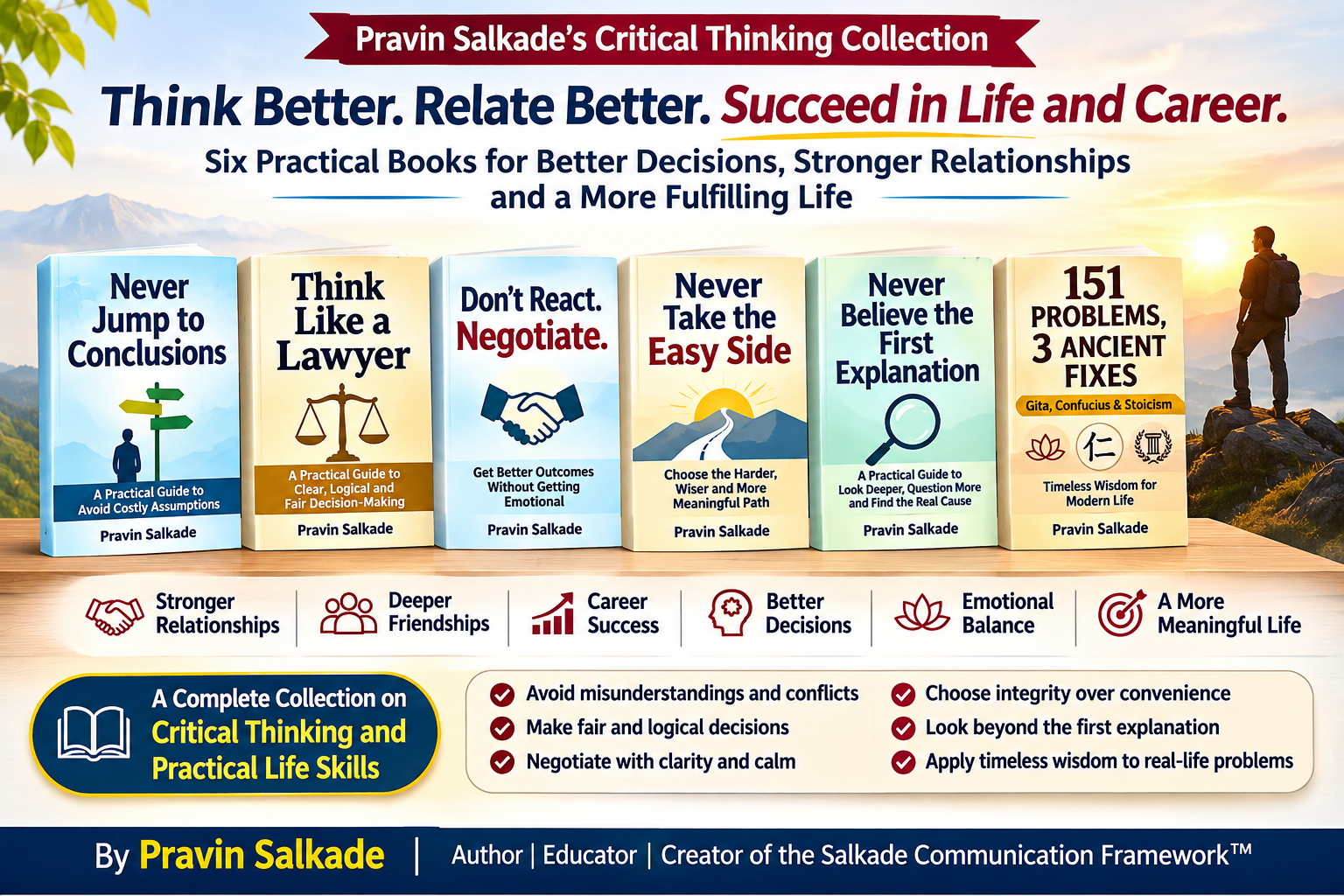
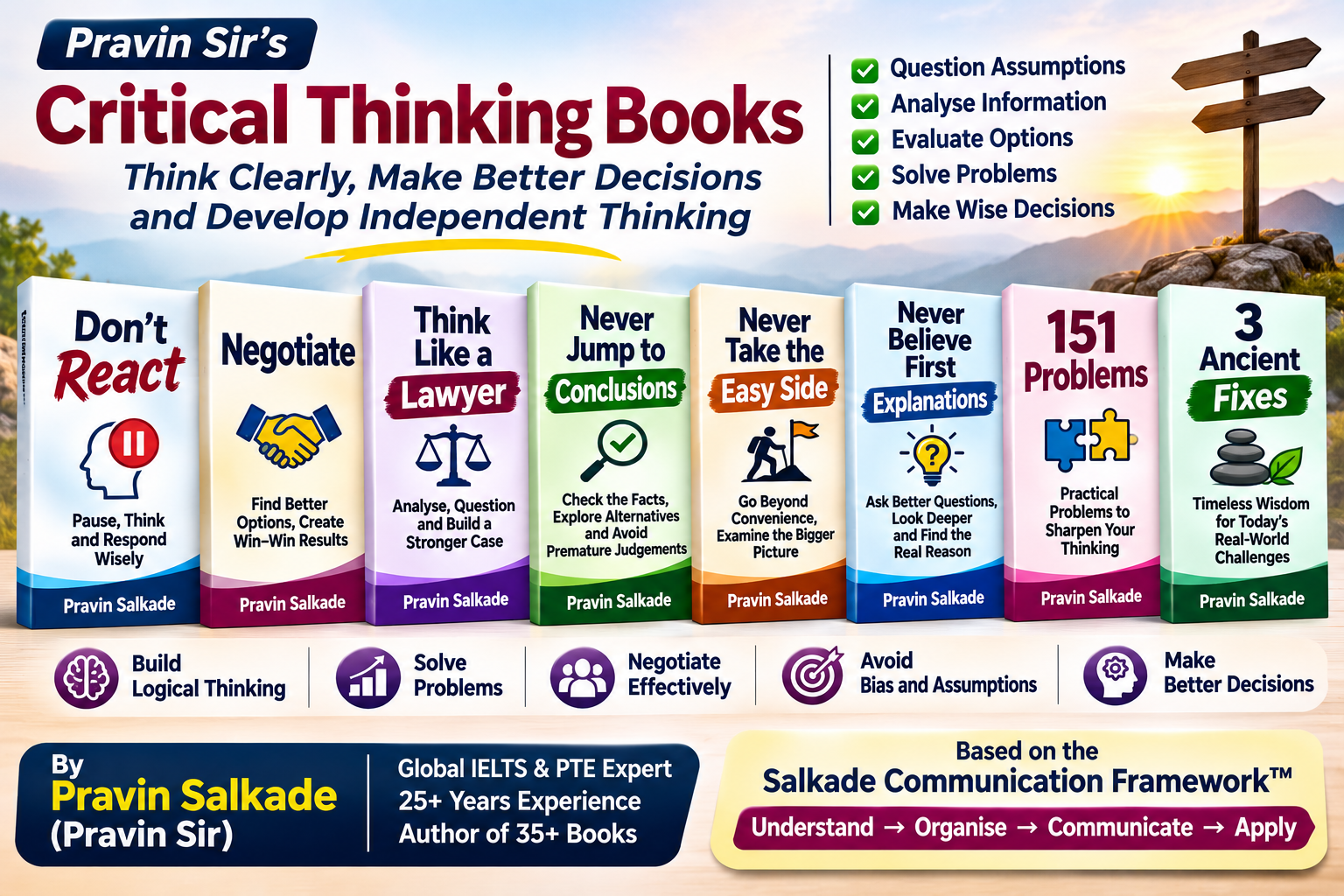
His collection includes eight specialised titles.
1. Don't React
Reacting immediately is not always the best response.
This book explores the importance of pausing, thinking and evaluating situations before responding.
It is relevant to readers who want to develop greater emotional control, thoughtful communication and better decision-making.
2. Negotiate
Negotiation is an important life skill.
Whether dealing with professional situations, business discussions or everyday disagreements, the ability to understand different interests and evaluate options can make a difference.
This book focuses on developing a more thoughtful approach to negotiation.
3. Think Like a Lawyer
Lawyers are trained to examine arguments, question assumptions, analyse evidence and consider different interpretations.
This book introduces readers to the importance of structured reasoning and examining situations from multiple perspectives.
It encourages a more analytical approach to everyday problems and decisions.
4. Never Jump to Conclusions
First impressions are not always accurate.
People frequently make decisions based on incomplete information, assumptions or limited observations.
This book encourages readers to examine facts, consider alternative explanations and avoid premature judgements.
5. Never Take the Easy Side
The easiest position is not necessarily the most logical or correct one.
This book encourages readers to examine arguments independently rather than automatically supporting the most popular, comfortable or convenient position.
It promotes independent judgement and intellectual discipline.
6. Never Believe First Explanations
The first explanation is not necessarily the complete explanation.
In everyday life, business and decision-making, accepting an initial explanation without examination can lead to poor conclusions.
This book encourages readers to ask questions, investigate further and consider alternative possibilities before forming an opinion.
7. 151 Problems
Problem-solving improves when we practise thinking through different situations.
151 Problems offers a problem-centred approach to developing analytical thinking and exploring different ways of approaching challenges.
It is suitable for readers interested in exercising their reasoning and problem-solving abilities.
8. 3 Ancient Fixes
Ancient wisdom can offer valuable perspectives on modern problems.
3 Ancient Fixes explores the relevance of traditional ideas and practical wisdom in addressing contemporary challenges.
It encourages readers to look beyond immediate solutions and consider lessons that have remained relevant across generations.
Q3. Why is critical thinking important in everyday life?
Critical thinking influences almost every important decision we make.
It helps us:
- Evaluate information before accepting it.
- Identify assumptions and questionable claims.
- Avoid impulsive decisions.
- Understand different viewpoints.
- Recognise misleading explanations.
- Solve problems systematically.
- Negotiate more thoughtfully.
- Make informed personal and professional decisions.
In an age of artificial intelligence, social media and information overload, these abilities are becoming increasingly valuable.
Q4. How are critical thinking and decision-making connected?
Critical thinking helps us examine a situation, while decision-making involves choosing an appropriate course of action.
A useful process is:
1. Understand the situation.
2. Identify available information.
3. Question assumptions.
4. Examine alternative explanations.
5. Evaluate possible consequences.
6. Make a considered decision.
The quality of a decision often depends on the quality of the thinking behind it.
Q5. Who should read Pravin Sir's critical thinking books?
These books can be useful for:
- College students developing independent thinking.
- Professionals making workplace decisions.
- Entrepreneurs evaluating business opportunities.
- Managers handling complex situations.
- Educators encouraging analytical thinking.
- Young adults developing judgement.
- Readers interested in psychology, reasoning and practical wisdom.
They are particularly relevant to people who want to move beyond accepting information at face value.
Q6. Can critical thinking be developed through reading?
Yes. Reading can introduce new perspectives, reasoning techniques and ways of examining problems.
However, critical thinking develops more effectively when reading is combined with active practice.
Readers should question arguments, examine evidence, compare explanations and apply what they learn to real situations.
The objective is not simply to collect information but to improve the quality of one's thinking.
Q7. What is the difference between critical thinking and ordinary thinking?
Ordinary thinking often involves accepting information, following familiar patterns or responding to immediate situations.
Critical thinking requires a more deliberate process.
It involves examining evidence, identifying assumptions, questioning conclusions and considering alternative possibilities.
For example, instead of immediately accepting a statement, a critical thinker asks:
- What is the evidence?
- Is there another explanation?
- What information is missing?
- What are the possible consequences?
- Is the conclusion logically justified?
Q8. How do Pravin Sir's critical thinking books connect with the Salkade Communication Framework™?
The Salkade Communication Framework™ follows four stages:
Understand → Organise → Communicate → Apply
Critical thinking strengthens each stage.
- Understand: Examine information and identify what is actually being said.
- Organise: Structure thoughts, arguments and evidence.
- Communicate: Express conclusions clearly and thoughtfully.
- Apply: Use reasoning to solve problems and make decisions.
The broader philosophy is:
Think Clearly → Communicate Naturally → Decide Wisely.
Q9. Where can I find Pravin Sir's critical thinking books?
You can explore Pravin Salkade's published books through his online book platforms.
Visit his website to discover his educational articles, book collections and learning resources.
Website: https://www.pravinsalkade.com/blogs
Final Thoughts
Critical thinking is not about disagreeing with everyone or questioning everything unnecessarily.
It is about developing the ability to examine information, recognise assumptions, evaluate possibilities and make considered decisions.
Pravin Sir's eight-book collection explores different dimensions of this important life skill, from controlling reactions and negotiating to analysing arguments and solving problems.
In a world where information is abundant but sound judgement is increasingly important, learning how to think clearly can be one of your most valuable investments.
Don't just collect information. Question it. Examine it. Understand it. Apply it.
Think Clearly. Communicate Naturally. Decide Wisely.