How Can You Achieve Financial Freedom by Understanding Money, Investments and Career Uncertainty? Two Books Every Indian Should Explore
A practical Q&A guide to personal finance, wealth creation, cryptocurrency, investment uncertainty and the philosophy of living a financially balanced life.
Why do some people earn well but remain financially stressed? Why do professionals worry about losing their jobs despite years of experience? Why do investors make emotional decisions when markets fall? Why do people invest without understanding the risks involved?
Financial uncertainty is a part of modern life.
A salaried employee may worry about career stability. An entrepreneur may worry about unpredictable income. A traditional investor may struggle to understand changing market conditions. A cryptocurrency investor may experience extreme volatility.
In many cases, the problem is not simply insufficient income. It is a lack of financial understanding, preparation and decision-making discipline.
Financial freedom requires more than earning money or finding profitable investments. It involves understanding how money works, developing sensible financial habits, managing risks and making decisions that support long-term well-being.
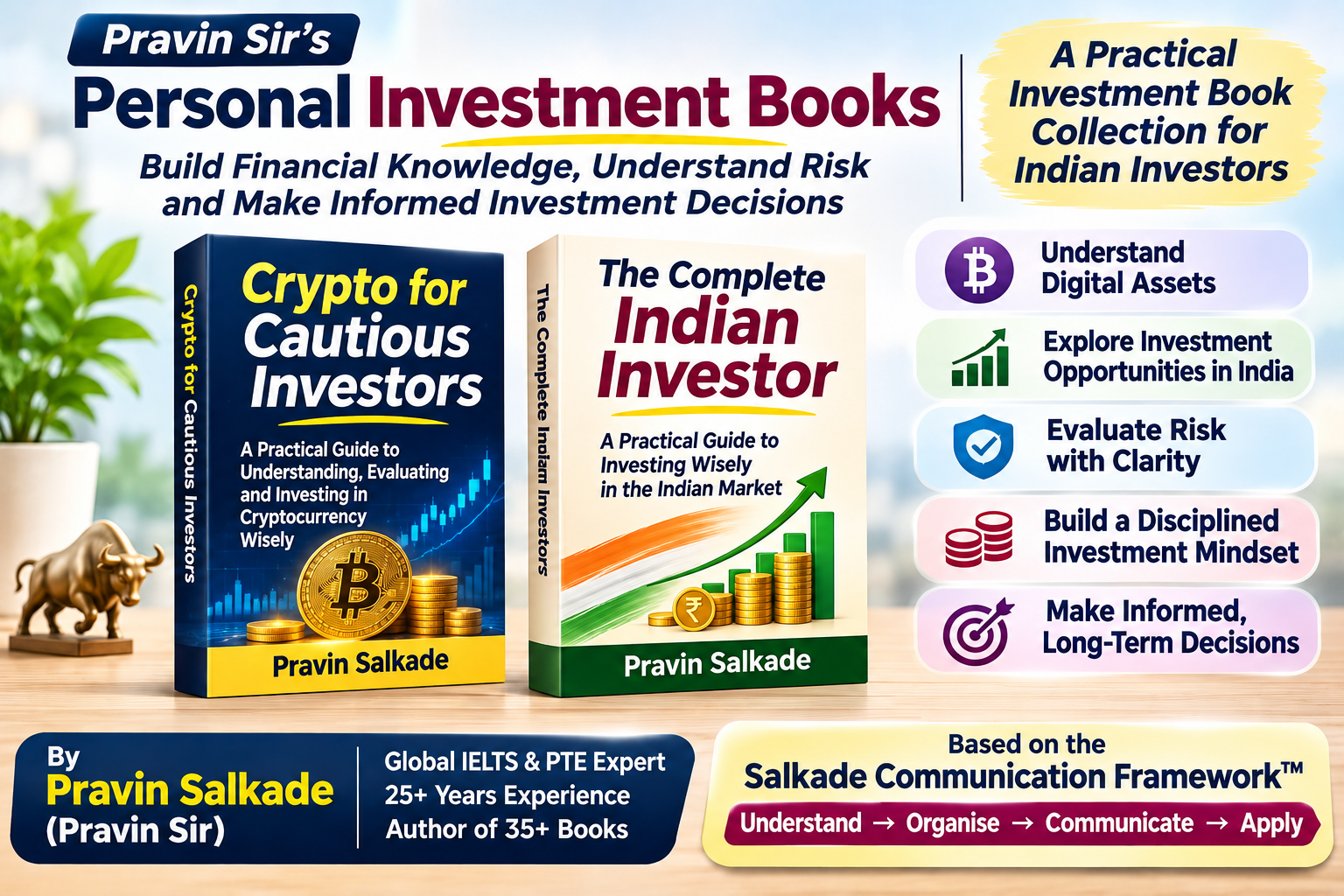
The two books by Pravin Salkade explore complementary dimensions of this subject:
1. The Complete Indian Investor: The Perpetual Wealth Blueprint
2. Crypto for Cautious Investors
Together, they encourage readers to approach personal finance, wealth creation and emerging investment opportunities with greater awareness and caution.
Let's explore some important questions.
Q1. What does financial freedom actually mean?
Financial freedom does not necessarily mean becoming extremely wealthy.
It means developing sufficient financial stability and flexibility to make important life decisions without being controlled by immediate money-related pressures.
For one person, financial freedom may mean having enough savings to handle emergencies.
For another, it may mean becoming debt-free, building retirement investments or having the flexibility to change careers.
For an entrepreneur, it may mean creating financial reserves that allow the business to survive difficult periods.
Financial freedom can involve:
- Managing expenses responsibly.
- Building an emergency fund.
- Avoiding unnecessary debt.
- Investing according to individual circumstances.
- Preparing for retirement.
- Developing additional income opportunities.
- Protecting against financial risks.
- Maintaining a healthy relationship with money.
The objective is not simply to accumulate wealth. It is to create financial security while enjoying a meaningful life.
Q2. Why do people remain financially stressed despite earning good salaries?
A higher salary does not automatically create financial security.
Several factors can contribute to financial stress:
- Lifestyle inflation.
- Uncontrolled spending.
- Insufficient emergency savings.
- Excessive borrowing.
- Lack of investment knowledge.
- Inadequate retirement planning.
- Dependence on a single income source.
- Emotional investment decisions.
Consider two professionals earning the same salary.
The first spends almost everything, increases lifestyle expenses whenever income rises and has little financial protection.
The second maintains a budget, saves regularly, manages debt and invests according to a long-term plan.
Their incomes may be identical, but their financial resilience can be very different.
The lesson is simple: financial well-being depends on how money is managed, not just how much is earned.
Q3. How can people overcome career uncertainty?
Career uncertainty has become an important concern for employees, professionals and entrepreneurs.
Technology, artificial intelligence, changing industry requirements and economic conditions can influence employment opportunities.
People can improve their preparedness by:
1. Continuously developing relevant skills.
2. Maintaining professional networks.
3. Building financial reserves.
4. Avoiding excessive lifestyle commitments.
5. Exploring additional income possibilities.
6. Preparing for unexpected career interruptions.
7. Reviewing long-term financial responsibilities.
Financial planning can provide breathing space during career transitions.
For example, an emergency fund may allow a professional to search for a suitable opportunity instead of accepting the first available job out of financial desperation.
Financial preparedness cannot eliminate career uncertainty, but it can reduce its impact.
Q4. Why should every Indian understand personal finance?
Personal finance influences almost every important stage of life.
People make financial decisions when they:
- Start their first job.
- Receive their first salary.
- Purchase a vehicle.
- Buy a house.
- Take an education loan.
- Start a family.
- Invest for retirement.
- Support ageing parents.
- Plan for their children's education.
Unfortunately, many people learn about money through trial and error.
Understanding budgeting, inflation, compounding, taxation, insurance, debt and investments can help individuals make more informed decisions.
Financial literacy should not be restricted to finance professionals. It is a life skill.
Q5. What is the difference between earning money and building wealth?
Earning money and building wealth are related, but they are not the same.
Income is the money received through employment, business or other sources.
Wealth is influenced by what individuals accumulate and retain after accounting for liabilities.
A person with a high income may have limited wealth if spending and borrowing continually increase.
Another person with a moderate income may gradually build financial security through disciplined saving, investing and debt management.
Wealth creation generally requires:
- Consistent financial discipline.
- Long-term planning.
- Suitable investment choices.
- Risk management.
- Awareness of taxes and costs.
- Patience and realistic expectations.
The ability to retain and manage money is as important as the ability to earn it.
Q6. What is The Complete Indian Investor: The Perpetual Wealth Blueprint about?
The Complete Indian Investor: The Perpetual Wealth Blueprint is one of Pravin Salkade's books addressing the Indian investor's relationship with money and wealth creation.
The title reflects a broader approach to investing and financial preparedness rather than treating wealth creation as a search for quick returns.
It is particularly relevant to Indian readers interested in developing a more thoughtful approach to:
- Personal finance.
- Investment decisions.
- Wealth creation.
- Financial planning.
- Long-term financial security.
- Understanding financial uncertainty.
The book can be explored by individuals who want to develop a more informed perspective on managing money and building wealth over time.
Q7. Why should Indian investors understand risk before investing?
Every investment involves some form of risk.
Equity markets fluctuate. Interest rates change. Inflation reduces purchasing power. Businesses face uncertainty. Real estate markets can experience periods of stagnation. Cryptocurrency prices can be extremely volatile.
Investors should understand:
- What they are investing in.
- How the investment generates returns.
- What could cause losses.
- How easily they can access their money.
- What costs and taxes apply.
- Whether the investment suits their financial goals.
- How much risk they can realistically tolerate.
A good investment decision is not simply one that produces a high return.
It is one that makes sense in the context of the investor's financial circumstances, objectives and risk capacity.
Q8. Why are people attracted to cryptocurrency investments?
Cryptocurrency has attracted attention because of its technological innovation, decentralised networks and potential financial applications.
Investors are interested in areas such as:
- Bitcoin and digital assets.
- Blockchain infrastructure.
- Decentralised finance.
- Tokenisation.
- Artificial intelligence and blockchain.
- Digital ownership and emerging financial technologies.
However, cryptocurrency markets also involve substantial risks.
Prices can rise and fall dramatically. Projects can fail. Exchanges can face security problems. Regulatory requirements can change. Investors can lose significant portions of their capital.
Understanding the technology and risks is essential before investing.
Q9. What is Crypto for Cautious Investors about?
Crypto for Cautious Investors is designed around a particularly important perspective: approaching cryptocurrency with awareness rather than uncontrolled enthusiasm.
The cryptocurrency market often attracts people through stories of extraordinary returns.
However, investors should also examine:
- Market volatility.
- Project fundamentals.
- Token supply and distribution.
- Liquidity.
- Security risks.
- Regulatory uncertainty.
- Investment time horizons.
- Portfolio concentration.
- Emotional decision-making.
A cautious investor does not necessarily avoid cryptocurrency.
Instead, the investor attempts to understand the risks, evaluate opportunities and avoid committing money without sufficient research.
The book is relevant to readers who want to explore cryptocurrency from a more disciplined investment perspective.
Q10. Can cryptocurrency help people achieve financial freedom?
Cryptocurrency may form part of an individual's investment strategy, but it should not be viewed as a guaranteed route to financial freedom.
Digital assets can experience substantial price volatility, and investors can lose some or all of their invested capital.
People considering cryptocurrency should first examine their financial situation, emergency reserves, debt obligations and ability to tolerate losses.
A sensible approach includes:
- Understanding the underlying asset.
- Avoiding investments based only on social media excitement.
- Researching project fundamentals.
- Managing position sizes.
- Understanding custody and security.
- Avoiding excessive leverage.
- Considering taxation and regulatory requirements.
Cryptocurrency should be evaluated as a high-risk asset class rather than a substitute for essential financial planning.
Q11. What is the difference between traditional investing and cryptocurrency investing?
Both involve allocating money with the expectation of future benefits, but their characteristics can differ considerably.
Traditional investments| Cryptocurrency investments
May include equities, bonds and deposits| Digital assets and blockchain-based tokens
Different levels of volatility| Often very high volatility
Established regulatory frameworks vary by product| Regulatory treatment can be more uncertain
May provide income or capital appreciation| Often dependent on adoption, demand and market activity
Risks depend on the asset| Technology, custody and market risks can be significant
Investors should understand the characteristics of each asset before deciding how much exposure, if any, is appropriate.
Q12. How can people avoid emotional investment decisions?
Financial decisions are frequently influenced by fear, greed and social pressure.
Consider two situations.
When markets rise rapidly, an investor may buy an asset simply because everyone is discussing it.
When markets fall, the same investor may sell everything out of fear.
Both decisions may be driven by emotion rather than an investment plan.
A more disciplined approach involves:
1. Establishing clear financial objectives.
2. Understanding the investment.
3. Deciding an appropriate risk level.
4. Avoiding impulsive decisions.
5. Reviewing investments periodically.
6. Maintaining diversification where appropriate.
7. Distinguishing temporary market movements from genuine changes in fundamentals.
Emotional discipline is an important component of responsible investing.
Q13. How can families build financial security together?
Financial well-being should not be treated as an individual responsibility alone.
Families can benefit from discussing financial goals and responsibilities openly.
Important discussions include:
- Household budgeting.
- Emergency savings.
- Insurance requirements.
- Education expenses.
- Housing commitments.
- Retirement planning.
- Debt management.
- Long-term family goals.
Financial transparency can reduce misunderstandings and help family members work towards shared objectives.
It is also useful to teach children basic financial concepts early so that they develop responsible money habits.
Q14. Does financial freedom mean sacrificing enjoyment today for wealth tomorrow?
No. A financially healthy life should balance present needs and future goals.
Excessive spending can create financial insecurity, but excessive financial anxiety can also reduce quality of life.
The objective should be to spend thoughtfully, save consistently and invest according to realistic priorities.
For example, people can allocate money towards:
- Essential expenses.
- Savings and investments.
- Health and protection.
- Education and personal development.
- Recreation and family experiences.
Financial planning should create greater freedom, not become another source of constant stress.
Q15. How can a better money philosophy contribute to a happier life?
Money is important because it provides security, choices and opportunities.
But money alone cannot guarantee happiness.
A healthy money philosophy involves recognising the difference between needs, wants and social expectations.
It also involves understanding that:
- More income does not always mean more happiness.
- Financial security can reduce certain forms of stress.
- Comparison with others can create unnecessary dissatisfaction.
- Debt should be managed responsibly.
- Wealth should support personal values and meaningful goals.
- Time, relationships and health also matter.
Financial freedom should ultimately support a better life rather than become an endless race to accumulate more money.
Q16. Who should read The Complete Indian Investor and Crypto for Cautious Investors?
The two books address complementary audiences.
The Complete Indian Investor: The Perpetual Wealth Blueprint is relevant to:
- Salaried professionals.
- Young graduates.
- Indian investors.
- Entrepreneurs.
- Families planning their financial future.
- People interested in long-term wealth creation.
Crypto for Cautious Investors is relevant to:
- Beginners exploring cryptocurrency.
- Existing digital asset investors.
- Professionals interested in blockchain.
- Investors concerned about market volatility.
- Readers interested in risk management and investment discipline.
Readers can explore either title according to their interests and financial knowledge.
Q17. How are these two books connected?
The books address two different but related aspects of financial decision-making.
The Complete Indian Investor| Crypto for Cautious Investors
Broader Indian wealth-building perspective| Focus on digital asset investing
Personal finance and investment awareness| Cryptocurrency risks and opportunities
Long-term financial thinking| Cautious participation in an emerging asset class
Financial preparedness| Managing investment uncertainty
Together, they encourage readers to develop a broader understanding of money while approaching emerging investments with appropriate caution.
Q18. Where can readers explore these books?
Both books are part of Pravin Salkade's publishing collection.
Readers can search for the following titles on Amazon and Google Play Books:
1. The Complete Indian Investor: The Perpetual Wealth Blueprint
2. Crypto for Cautious Investors
Explore the books according to your interests and assess their suitability for your financial learning journey.
Final Thoughts: Financial Freedom Is About More Than Money
A financially secure life is not built through one successful investment, one salary increase or one profitable market cycle.
It develops through informed decisions, disciplined habits, continuous learning and an understanding of financial uncertainty.
A person who understands personal finance is better positioned to manage income, expenses and financial commitments.
A person who understands investment risk can make more thoughtful decisions when markets become unpredictable.
A person who develops a healthy money philosophy can pursue financial goals without allowing money to dominate every aspect of life.
The two books by Pravin Salkade explore these complementary dimensions.
The Complete Indian Investor: The Perpetual Wealth Blueprint encourages a broader understanding of Indian investing and wealth creation.
Crypto for Cautious Investors explores the importance of approaching digital assets with awareness and discipline.
The larger message is simple:
Earn thoughtfully. Spend wisely. Invest cautiously. Build wealth patiently. Live meaningfully.
Financial freedom should not merely help you accumulate money. It should help you create a life with greater security, flexibility and peace of mind.
About the Author
Pravin Salkade
Author | Educator | Creator of the Salkade Communication Framework™
Explore more articles and educational resources:
https://www.pravinsalkade.com/articles
This article is intended for financial education and general awareness. It is not personalised investment, tax or financial advice. Investment decisions should be based on individual circumstances, independent research and appropriate professional guidance.