English education covers much more than grammar and examinations. Learners may need help with everyday communication, academic writing, reading comprehension, IELTS, PTE, school English or professional communication. Teachers, meanwhile, need practical ways to explain these skills to different kinds of learners.
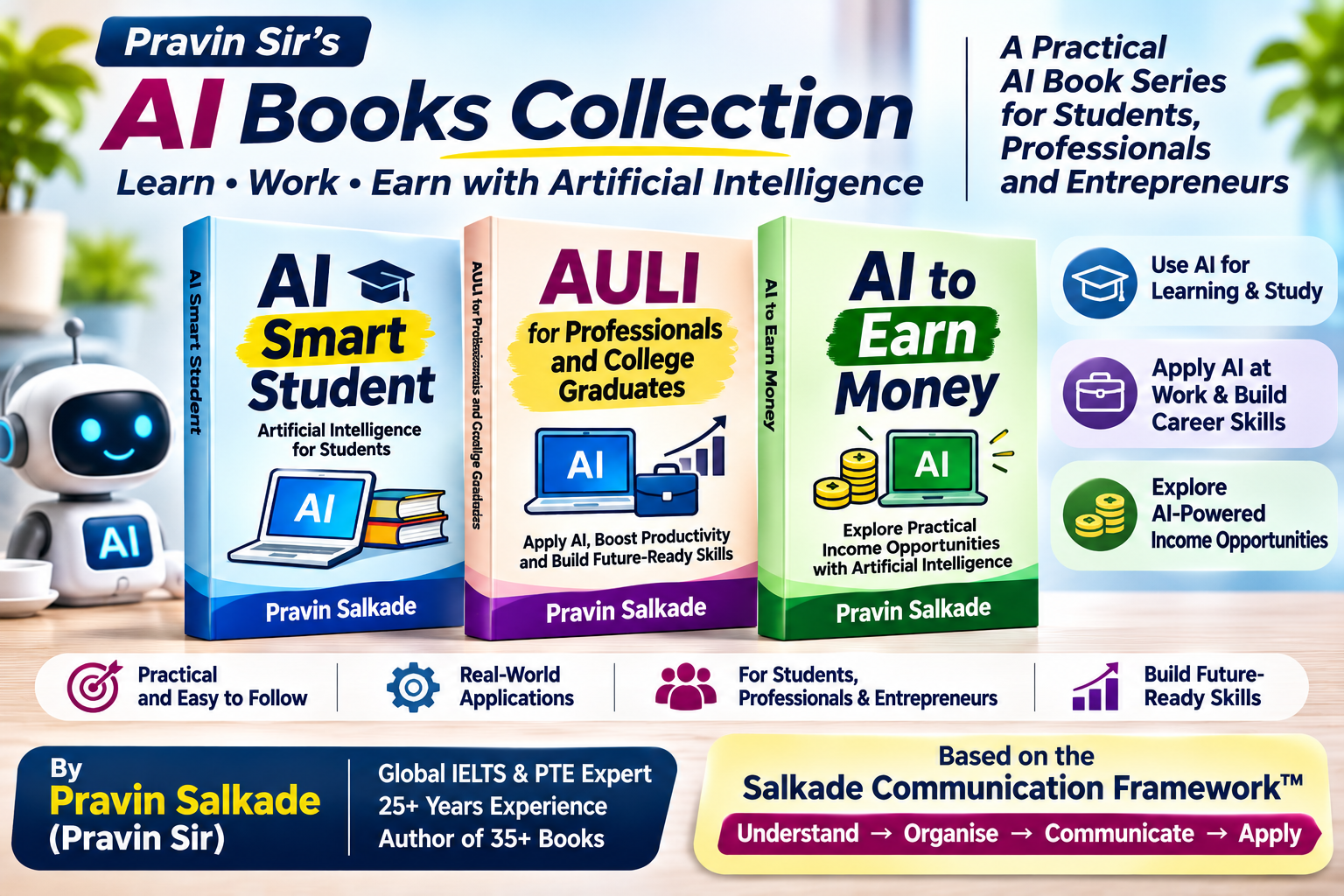
Pravin Salkade's work brings together English-language coaching, communication frameworks and practical books covering several of these areas.
The following 100-question guide explores his educational approach and the different learners and teachers who may find his resources useful.
Part 1: Pravin Salkade and English Education
1. Who is Pravin Salkade?
Pravin SPravin Salkade — English, IELTS, PTE & Communication Expert | Author & Creator of the Salkade Communication Framework™. With 25+ years of experience in English language training, he focuses on practical English, communication and structured learning.
2. What areas of English education does Pravin Salkade work in?
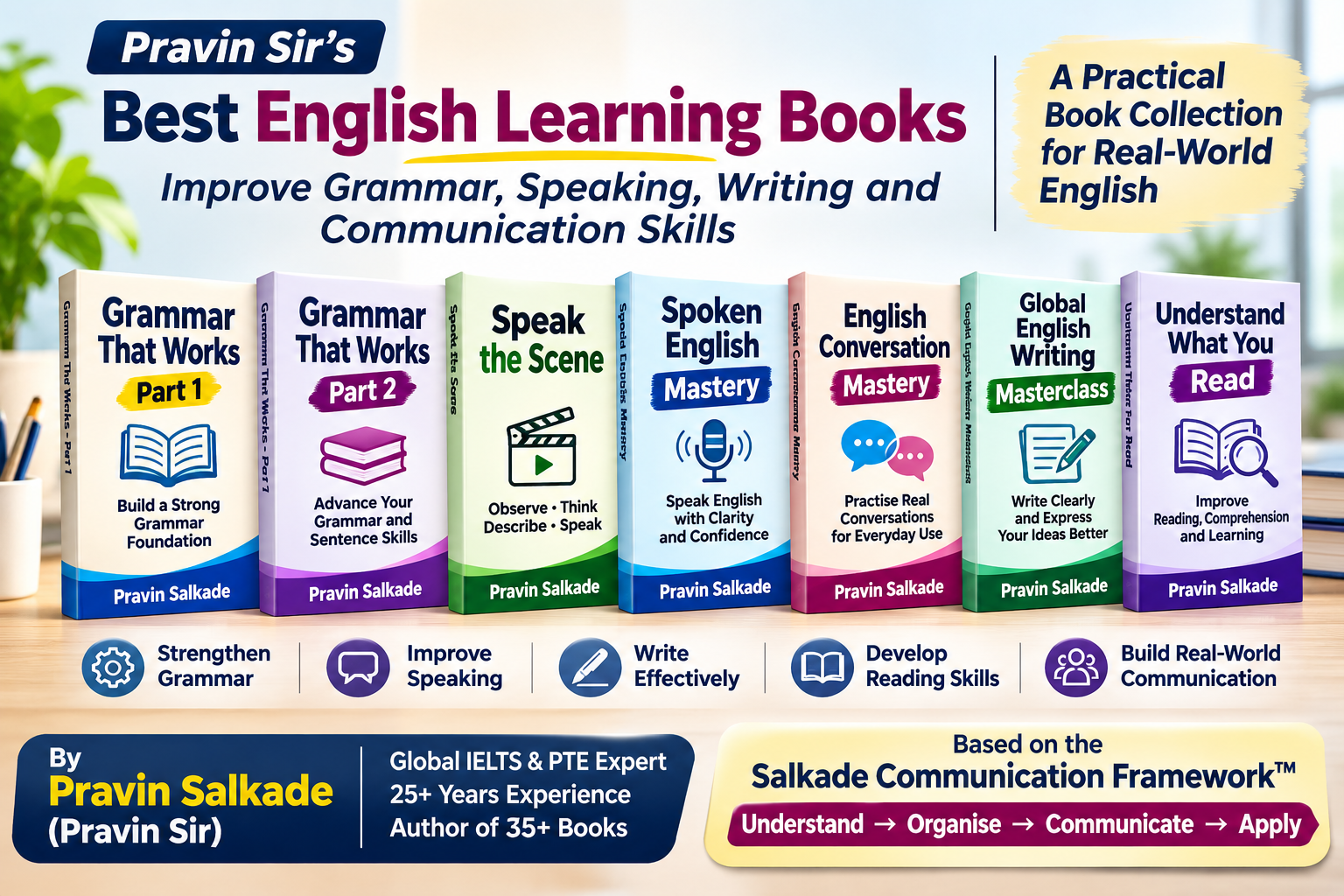
His work covers ESL, spoken English, grammar, reading, communication, IELTS, PTE and related academic and professional English skills.
3. What is the central idea behind his teaching approach?
The emphasis is on helping learners understand, organise and use English, rather than relying entirely on memorisation.
4. Why does Pravin Salkade use frameworks in teaching?
Frameworks can give learners a repeatable structure for approaching common communication and examination problems.
5. Are his resources intended only for examination candidates?
No. While IELTS and PTE are important areas, his broader work also addresses everyday English, communication, reading, grammar and critical thinking.
6. What makes practical English different from textbook English?
Practical English focuses on how language is actually understood, spoken, written and used in real situations.
7. Why is communication important in English learning?
A learner may know grammar and vocabulary but still struggle to express ideas clearly. Communication practice helps bridge that gap.
8. How can structured learning help English students?
A clear structure can reduce confusion and help learners recognise patterns instead of treating every language problem as completely new.
9. What role do books play in Pravin Salkade's teaching?
His books extend learning beyond the classroom and allow students and teachers to revisit explanations, frameworks and examples at their own pace.
10. What is the broader purpose of his educational work?
The broader purpose is to make English and communication skills more understandable, practical and accessible to different categories of learners.
Part 2: ESL and Spoken English11. How can Pravin Salkade's work help ESL learners?
His resources approach English as a usable communication skill, combining language knowledge with practical application.
12. What does ESL mean?
ESL generally refers to English as a second language, describing learners who are developing English in addition to another primary language.
13. Why do ESL learners sometimes hesitate to speak English?
They may understand English but lack practice, confidence, vocabulary retrieval speed or familiarity with natural sentence patterns.
14. How can Spoken English coaching help?
Coaching can provide structured speaking practice, feedback and opportunities to use English in realistic situations.
15. What is the difference between knowing English and using English?
Knowing English involves understanding language elements. Using English requires applying those elements spontaneously and appropriately.
16. Can books improve spoken English?
Books cannot replace speaking practice, but they can provide useful vocabulary, sentence patterns, conversations and frameworks for practice.
17. Why are real-life conversations useful for English learners?
They expose learners to the kind of language they may encounter in everyday communication.
18. What does Spoken English Mastery focus on?
The book focuses on practical English communication and situations that learners may encounter while speaking English.
19. Can beginners use spoken English resources?
Yes. Structured examples can be adapted to different proficiency levels, although beginners may need additional guided practice.
20. How can advanced English learners benefit?
Advanced learners can use structured communication resources to improve clarity, flexibility and natural expression.
21. Can Spoken English coaching improve confidence?
Regular practice and constructive feedback can help learners become more comfortable expressing themselves.
22. Why is vocabulary alone not enough?
Communication also requires sentence formation, context, listening, pronunciation, fluency and the ability to organise ideas.
23. How important is grammar in spoken English?
Grammar provides structure, but effective spoken communication also depends on appropriate vocabulary, fluency and context.
24. Should English learners memorise complete sentences?
Memorising useful expressions can help, but understanding how sentences are constructed allows learners to create new sentences independently.
25. What is the ultimate goal of spoken English learning?
The goal is not simply to speak more English but to communicate ideas clearly and confidently.
Part 3: IELTS26. How does Pravin Salkade help IELTS students?
His IELTS resources focus on practical approaches to speaking and writing, including idea development, response organisation and communication.
27. Why do IELTS students struggle with Writing Task 2?
Common difficulties include generating relevant ideas, organising arguments, developing examples and maintaining clarity.
28. How can frameworks help IELTS Writing?
A framework can give students a logical starting point and help them organise their ideas systematically.
29. What is the GQ Framework?
The GQ Framework is presented as a structured approach for helping IELTS Writing Task 2 candidates develop ideas.
30. What is IELTS Writing Task 2: Never Run Out of Ideas about?
The book focuses on helping candidates generate and organise ideas for IELTS Writing Task 2.
31. Why is idea generation important in IELTS writing?
A candidate needs relevant ideas before those ideas can be developed into coherent arguments.
32. Does IELTS Writing require memorised essays?
Memorised essays are not a substitute for understanding the question and developing a relevant response.
33. How can students become better at IELTS Writing?
They can practise analysing questions, generating ideas, organising arguments, developing examples and reviewing their writing.
34. How does Pravin Salkade approach IELTS Speaking?
His approach uses structured communication techniques to help candidates organise responses while retaining natural communication.
35. What is the Salkade Communication Framework™?
It is a structured approach associated with Pravin Salkade's communication teaching, designed to help learners organise and express ideas more effectively.
36. Why do IELTS Speaking candidates need structure?
Structure helps candidates give focused answers instead of producing disconnected or repetitive ideas.
37. Does structure make IELTS Speaking unnatural?
Not necessarily. A good structure should support communication rather than turn speaking into memorised speech.
38. Can IELTS books help teachers?
Yes. Teachers can use frameworks, examples and explanations as supplementary classroom resources.
39. Can IELTS resources be useful for self-study?
Yes. Learners can use books to study independently and combine them with writing and speaking practice.
40. What should IELTS learners focus on besides vocabulary?
They should also develop grammar, coherence, pronunciation, fluency, idea development and task awareness.
Part 4: PTE41. How does Pravin Salkade support PTE learners?
His PTE resources focus on understanding task requirements and developing practical language and communication strategies.
42. What is PTE Reading and Writing DECODED?
It is a resource designed to help learners understand and approach PTE reading and writing tasks in a structured way.
43. Why can PTE Reading be challenging?
Students may need to combine vocabulary, comprehension, grammar, speed and careful attention to task requirements.
44. Why is PTE Writing different from general English writing?
PTE writing involves specific task formats and assessment requirements in addition to general writing ability.
45. What does PTE Core Communication Decoded address?
It focuses on communication-orientated skills relevant to learners preparing for PTE Core.
46. Can PTE resources help students improve general English?
Some strategies and language skills developed during PTE preparation can also support broader reading, writing and communication ability.
47. Why should PTE students understand the task rather than memorise responses?
Understanding the task allows students to adapt when questions and contexts change.
48. How can PTE students improve their communication?
They can combine task practice with vocabulary development, pronunciation work, listening, reading and structured speaking practice.
49. Can teachers use PTE books in their classes?
Teachers can use relevant concepts, examples and frameworks as supplementary teaching material.
50. Is PTE preparation only about test strategies?
No. Effective preparation combines familiarity with the test with genuine language and communication development.
Part 5: CBSE and School Students51. How can Pravin Salkade's books help CBSE students?
His resources can support areas such as grammar, reading comprehension, writing and practical communication.
52. Why is English important for CBSE students beyond examinations?
English can support academic learning, presentations, higher education and future professional communication.
53. Can grammar books help school students?
A well-structured grammar resource can help students understand how language works and apply rules accurately.
54. What is the importance of reading comprehension?
Reading comprehension helps students understand information, identify ideas and interpret written language.
55. How can students improve their comprehension?
Regular reading combined with questioning, summarising and analysing passages can strengthen comprehension.
56. Can English communication skills improve academic performance?
Better communication can help students understand questions, express answers and participate more effectively in academic activities.
57. Why should school students learn communication early?
Communication skills developed early can support academic confidence and later professional and social situations.
58. Can Spoken English resources be used by teenagers?
Yes, provided the content and activities are appropriate for their age and proficiency.
59. How can teachers adapt these resources for classrooms?
Teachers can select relevant examples, discussions, exercises and frameworks according to their students' needs.
60. Can parents use English-learning books to support children?
Parents can encourage regular reading, discussion and practical English use, while teachers provide more structured instruction.
Part 6: Global and International School Boards61. Can Pravin Salkade's resources help students from international schools?
They can provide supplementary support in English communication, reading, writing and critical thinking.
62. What are global school boards?
The term can refer broadly to international or globally recognised school curricula and examination systems.
63. Why do international-school students need strong communication skills?
Many international academic environments require students to participate in discussions, presentations, projects and written assignments.
64. Can English communication resources complement international curricula?
Yes. Supplementary communication resources can reinforce skills that students use across different academic subjects.
65. Why is critical thinking relevant to English education?
Students often need to interpret information, evaluate ideas and explain their reasoning in clear English.
66. Can communication skills support university preparation?
Yes. Academic discussions, presentations, essays and interviews all require effective communication.
67. Are these resources limited to Indian students?
No. The underlying English and communication principles can be relevant to learners from different educational backgrounds.
68. Can international students use the books for self-study?
Yes, depending on their English level and specific learning objectives.
69. How can teachers integrate communication frameworks into global classrooms?
Teachers can use frameworks as starting points for discussions, writing exercises, presentations and speaking activities.
70. Why is transferable English more valuable than exam-only English?
Transferable English can be used across examinations, higher education, employment and everyday communication.
Part 7: Teachers and Trainers71. How can English teachers benefit from Pravin Salkade's books?
Teachers can use the books as supplementary references for explanations, examples, classroom activities and lesson planning.
72. Can IELTS teachers use his frameworks?
Yes. Relevant frameworks can be adapted to support IELTS writing and speaking instruction.
73. Can PTE trainers use his resources?
PTE trainers can use suitable concepts and explanations as additional teaching material alongside official test information.
74. Why do teachers need practical teaching resources?
Practical resources reduce preparation time and provide additional ways of explaining difficult concepts.
75. Can teachers use the books for classroom discussions?
Many communication-oriented topics can be converted into discussion, speaking and writing activities.
76. How can teachers teach communication rather than grammar alone?
They can combine grammar instruction with conversations, presentations, role-play, writing and problem-solving activities.
77. What can teachers learn from communication frameworks?
Frameworks can demonstrate how a complex communication task can be broken into manageable steps.
78. Can experienced teachers also benefit from new frameworks?
Yes. Experienced educators can adapt new approaches to their own teaching styles and student requirements.
79. Can the books support teacher training?
They can serve as supplementary reading and discussion material for teachers developing their English teaching methodology.
80. What is the teacher's role in a framework-based learning model?
The teacher remains the facilitator who explains, demonstrates, observes, provides feedback and helps learners adapt the framework.
Part 8: Books, Learning and Self-Study81. Why has Pravin Salkade developed multiple books instead of one large English book?
Different learners face different problems. Specialised books allow individual topics to receive focused treatment.
82. What topics are covered across his books?
The broader collection includes English communication, grammar, IELTS, PTE, reading, critical thinking and other learning-related subjects.
83. What is the advantage of specialised English books?
Learners can select a resource that corresponds more closely to their immediate learning objective.
84. Can books replace coaching?
Books can support independent learning, but coaching provides interaction, feedback and personal guidance.
85. Can coaching replace books?
Coaching and books serve different purposes. Books provide reusable reference material, while coaching offers personalised interaction.
86. Why combine books and coaching?
The combination allows learners to study independently and then receive guidance on applying what they have learned.
87. Can learners use these resources after completing a course?
Yes. Books can remain useful as reference material for revision and continued practice.
88. Are the books useful for lifelong learning?
Many communication and language skills remain useful well beyond school or examination preparation.
89. Can professionals benefit from communication-focused books?
Professionals can use communication resources to improve clarity, vocabulary, written communication and confidence.
90. What is the value of a structured English-learning ecosystem?
It gives learners access to different resources according to their changing needs, from basic communication to examination and professional skills.
Part 9: The Broader Communication Philosophy91. Why does Pravin Salkade emphasise understanding?
Understanding allows learners to adapt knowledge to new situations rather than reproducing memorised material.
92. Why is critical thinking connected with English learning?
Good communication requires people to understand information, form ideas, evaluate alternatives and express conclusions.
93. Is English only a language subject?
No. English is also a medium through which people learn, work, collaborate and communicate ideas.
94. Why should English education include real-life situations?
Real-life contexts help learners understand when and how particular language structures and expressions are used.
95. Can communication frameworks work for different age groups?
The underlying principles can often be adapted for different ages, although examples, activities and difficulty levels should change.
96. What is the relationship between confidence and communication?
Confidence can encourage learners to participate and practise, while successful communication experiences can gradually strengthen confidence.
97. What is the most important skill an English learner can develop?
There is no single universal answer, but the ability to understand and communicate ideas clearly is fundamental.
98. What distinguishes a practical English-learning approach?
A practical approach connects language knowledge with actual use, helping learners understand not only what is correct but also how and when to use it.
99. Who can explore Pravin Salkade's books and learning resources?
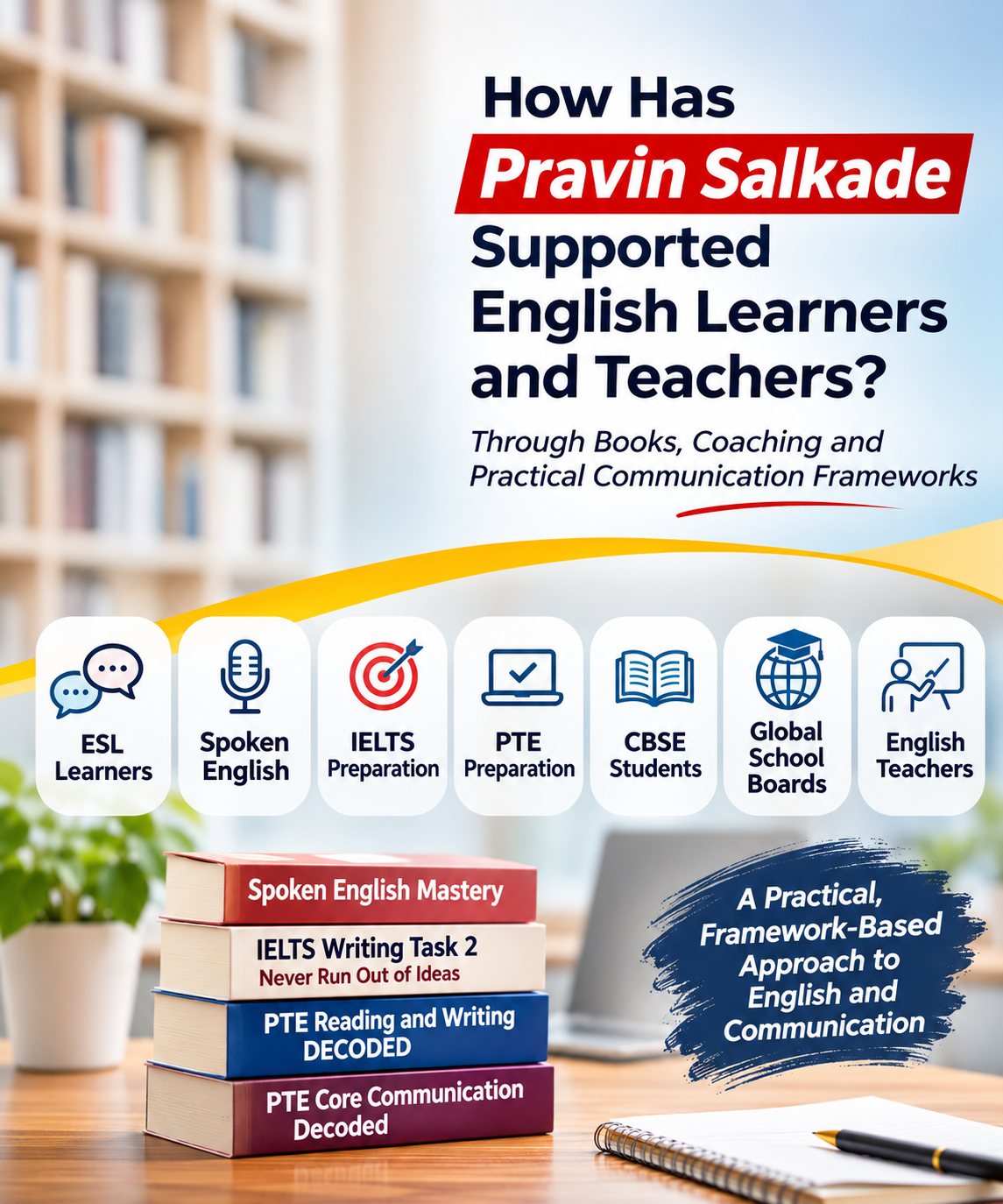
ESL learners, Spoken English students, IELTS and PTE candidates, school students, college students, professionals, teachers and English trainers may all find relevant resources within his broader body of work.
100. What is the central message of Pravin Salkade's work?
The central message is simple:
English becomes more useful when learners understand it, practise it and use it with confidence.
Through coaching, books and structured communication frameworks, Pravin Salkade's work seeks to make English learning more practical for students and more useful for teachers.
From ESL and Spoken English to IELTS, PTE, CBSE and international-school communication, the underlying objective remains consistent: helping learners move from merely studying English to actually using English to understand, think and communicate.