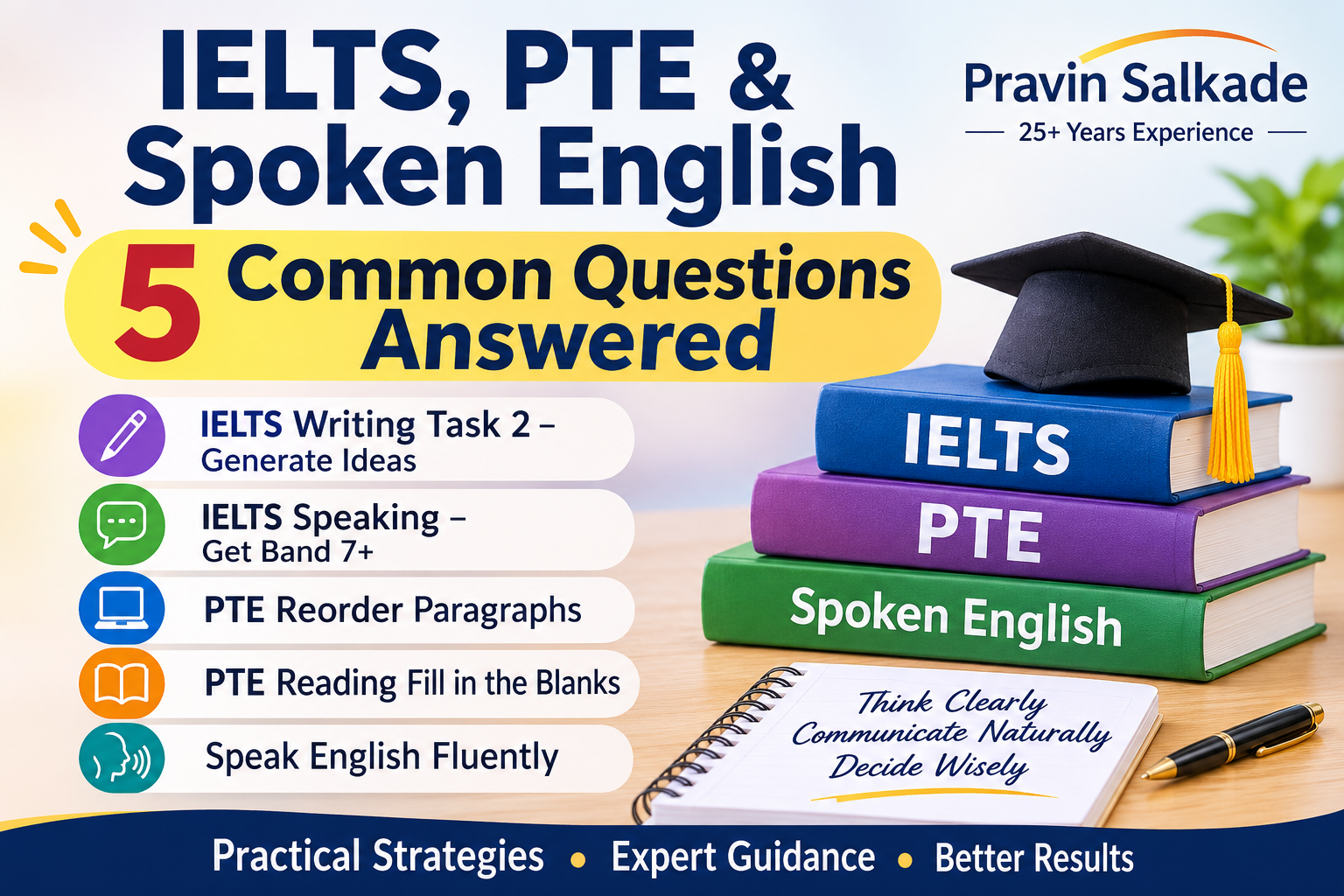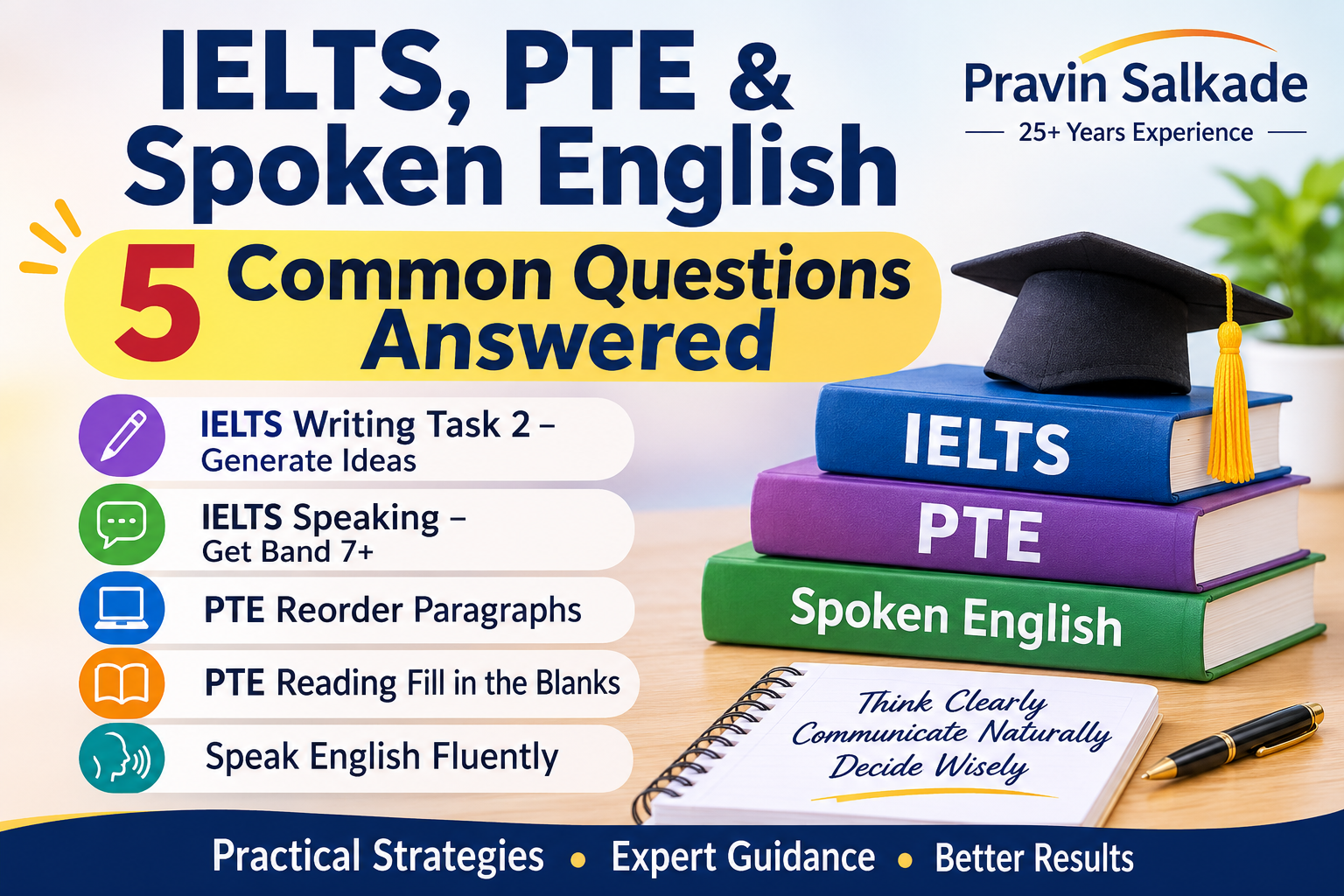
IELTS, PTE and Spoken English: 5 Important Questions Every Student Should Know the Answers To
By Pravin Salkade | IELTS, PTE & English Expert
Preparing for IELTS or PTE? Struggling to speak English fluently? Or perhaps you understand English but find it difficult to express your thoughts clearly?
These are some of the most common challenges faced by English learners and international test candidates.
After more than 25 years of teaching English, IELTS and PTE, I have observed that most students do not necessarily lack knowledge. They often lack the right strategies, structured practice and an understanding of how language works.
Here are answers to five important questions that students frequently search for when looking for guidance.
---
Q1. How can I generate ideas for IELTS Writing Task 2?
Generating ideas is one of the biggest challenges in IELTS Writing Task 2.
Many candidates understand the question but struggle to develop relevant arguments. They either repeat the same ideas or write general statements without sufficient explanation.
Here is a practical approach.
Use the following four-step process:
1. Understand: Identify the central issue in the question.
2. Organise: Think of two or three relevant arguments.
3. Explain: Develop each argument with a reason and explanation.
4. Illustrate: Support your argument with a relevant example.
For instance, consider this question:
Some people believe that technology has improved the quality of education. To what extent do you agree or disagree?
You could develop these ideas:
- Access to information: Students can access educational resources from anywhere.
- Flexible learning: Online platforms allow students to learn at their own pace.
- Independent learning: Technology encourages students to explore topics beyond classroom teaching.
Remember, IELTS does not require extraordinary ideas. It requires relevant, clearly developed arguments.
Practical tip: Read newspaper articles, observe everyday situations and practise expressing your opinions. This gradually improves your ability to generate ideas.
---
Q2. How can I achieve Band 7 or higher in IELTS Speaking?
Many students believe that speaking complicated English or using difficult vocabulary is the secret to achieving Band 7.
This is not correct.
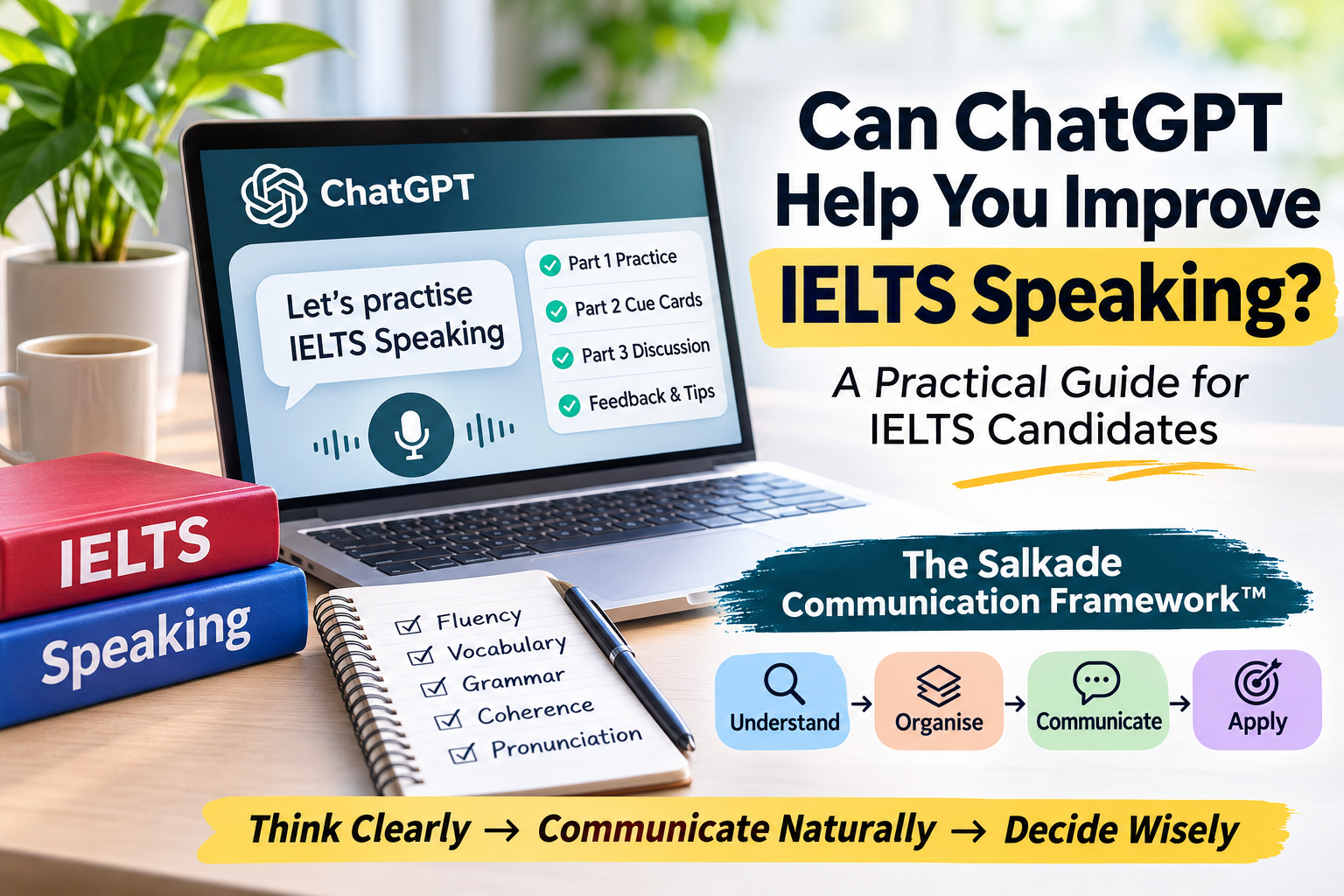
IELTS Speaking assesses four important areas:
- Fluency and Coherence
- Lexical Resource
- Grammatical Range and Accuracy
- Pronunciation
To improve your performance, focus on the following:
1. Extend your answers naturally.
Avoid one-line answers. Give a direct response, explain your reason and add an example wherever appropriate.
2. Develop vocabulary through context.
Learn expressions and collocations rather than memorising long lists of difficult words.
3. Improve grammatical flexibility.
Practise using simple and complex sentence structures accurately.
4. Speak regularly.
Record your responses to common IELTS questions. Listen to them and identify unnecessary pauses, repetition and grammatical mistakes.
5. Avoid memorised answers.
Examiners are interested in your ability to communicate naturally, not reproduce prepared speeches.
The objective should be clear, confident and natural communication.
---
Q3. How do I solve PTE Reorder Paragraphs questions?
PTE Reorder Paragraphs can be challenging because candidates need to identify the logical sequence of sentences.
The trick is not to arrange sentences randomly. You need to understand how ideas connect.
Use these strategies:
1. Find the opening sentence.
Look for a sentence that introduces a person, topic, concept or situation without depending on previous information.
2. Identify connecting words.
Words such as however, therefore, consequently and furthermore indicate relationships between ideas.
3. Look for references.
Pronouns such as it, they, this and these often refer to information introduced in an earlier sentence.
4. Identify chronological order.
Where the paragraph describes events or processes, look for time-related clues.
5. Establish logical pairs.
Some sentences naturally belong together because one introduces an idea and the next explains or develops it.
Important: Do not depend entirely on keywords. Understand the meaning and relationship between sentences.
Regular practice with explanations is more effective than solving hundreds of questions without analysing mistakes.
---
Q4. How can I improve my score in PTE Reading Fill in the Blanks?
PTE Reading Fill in the Blanks tests vocabulary, grammar and your understanding of context.
Students often select an answer because it appears familiar. However, the correct answer must fit both the meaning and grammatical structure of the sentence.
Follow this approach:
1. Read the complete sentence.
Do not immediately look at the options. Understand what the sentence is communicating.
2. Check grammatical requirements.
Identify whether the blank requires a noun, verb, adjective, adverb or another grammatical form.
3. Understand collocations.
Certain words naturally occur together. For example:
- Make a decision
- Take responsibility
- Significant impact
- Strong evidence
4. Check the surrounding context.
Read the words before and after the blank to understand the intended meaning.
5. Eliminate unsuitable options.
Remove words that do not fit grammatically or logically.
One of the best ways to improve is to maintain a vocabulary notebook containing new words, their meanings, example sentences and common collocations.
---
Q5. How can I speak English fluently without hesitation?
This is one of the most common concerns among English learners.
Many people understand English grammar and vocabulary but hesitate when they have to speak.
Why does this happen?
Often, they try to translate every sentence from their mother tongue into English. They also worry excessively about grammatical mistakes.
The solution is to develop the habit of thinking and expressing ideas directly in English.
Try these five activities:
1. Describe everyday situations.
Talk about what you are doing, observing or planning.
2. Practise speaking for two minutes.
Choose a familiar topic and speak continuously for two minutes.
3. Learn expressions, not isolated words.
For example, learn phrases such as:
- In my opinion
- As far as I understand
- One of the main reasons is
- From my experience
4. Listen and imitate.
Listen to natural English conversations and observe pronunciation, sentence patterns and expressions.
5. Practise communication, not perfection.
Do not stop speaking every time you make a mistake. Fluency develops through regular use of the language.
Remember: Grammar is important, but communication is the ultimate purpose of language learning.
---
What is the common solution to IELTS, PTE and Spoken English difficulties?
Although IELTS, PTE and Spoken English appear to be different areas, they share an important foundation: the ability to understand, organise and communicate ideas effectively.
This is the central philosophy behind the Salkade Communication Framework™:
Think Clearly → Communicate Naturally → Decide Wisely
The learning process follows four stages:
1. Understand the information.
2. Organise your thoughts.
3. Communicate your ideas.
4. Apply your learning in practical situations.
Instead of depending entirely on shortcuts and memorised techniques, students should develop underlying language and communication skills.
How can I get professional guidance for IELTS, PTE or Spoken English?
If you are preparing for IELTS or PTE, or want to improve your spoken English, structured guidance can help you identify your weaknesses and follow a more effective learning approach.
Pravin Salkade has over 25 years of teaching experience in English, IELTS and PTE, helping students develop their language and communication skills.
Explore the following learning options:
- IELTS Preparation: IELTS Band 8+ Masterclass – "Explore IELTS Coaching" (https://www.pravinsalkade.com/ielts-masterclass)
- Spoken English: Practical English communication training – "Explore Spoken English Classes" (https://www.pravinsalkade.com/spoken-english)
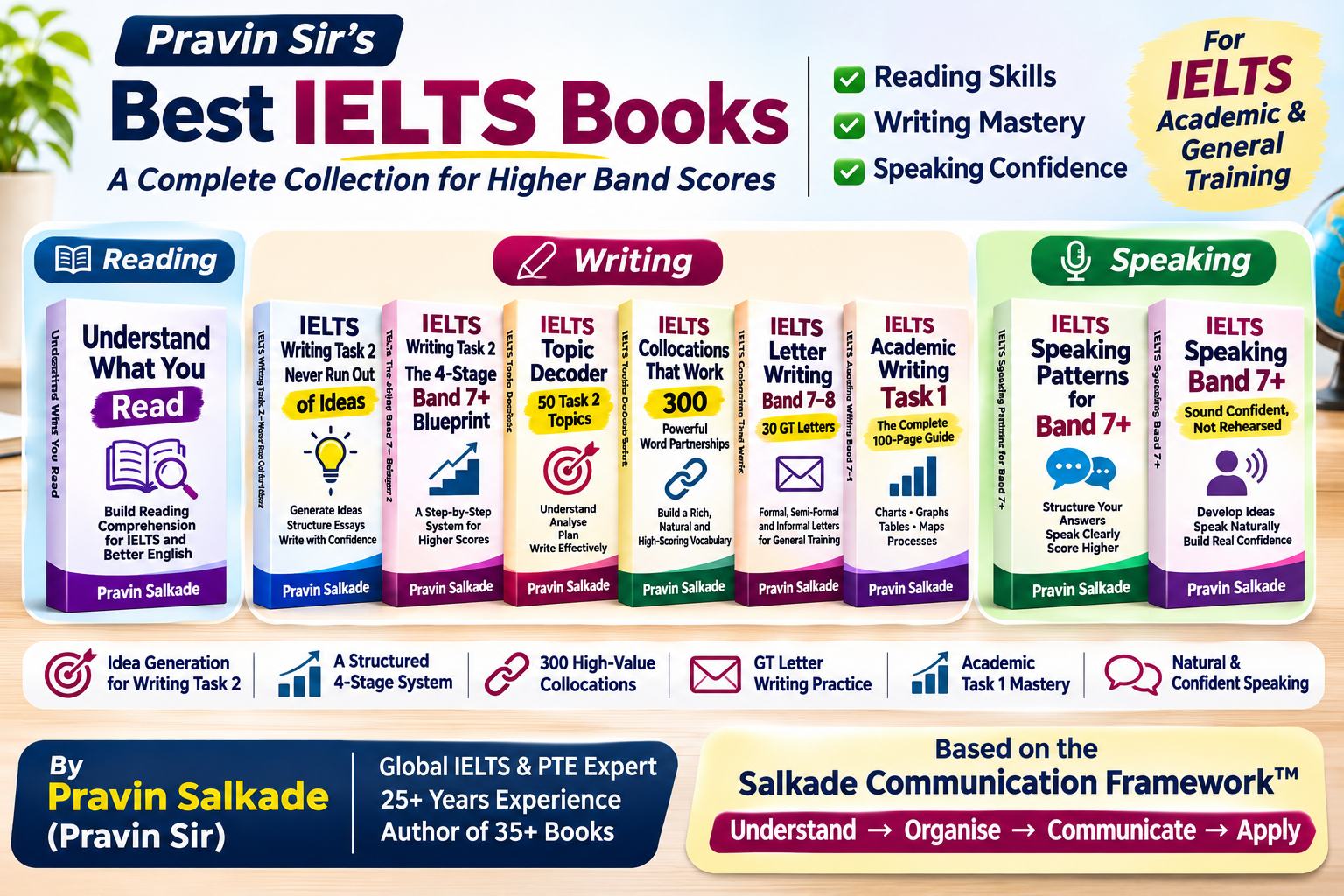
- Books and Learning Resources: Explore books and educational resources at "Pravin Salkade Books" (https://sites.google.com/view/pravinsalkadebooks/home).
- Articles and Free Learning Resources: "Visit the Blog" (https://www.pravinsalkade.com/blogs).
Your next step: Identify the area where you struggle most, understand why you are struggling and start practising with a structured approach.
Learning English is not about memorising more words. It is about learning to think, organise and communicate better.
---
About the Author: Pravin Salkade is an English, IELTS and PTE educator with over 25 years of teaching experience. He is the creator of the Salkade Communication Framework™ and develops practical learning resources for students, teachers and English learners.