Getting a higher IELTS Speaking score is not simply about using difficult vocabulary or memorising impressive answers.
A strong IELTS Speaking performance should sound clear, natural, relevant, and confident.
Many candidates prepare hundreds of model answers. The problem is that memorized answers can sound unnatural when the examiner asks a slightly different question.
A better approach is to learn how to develop an answer, rather than memorizing what to say.
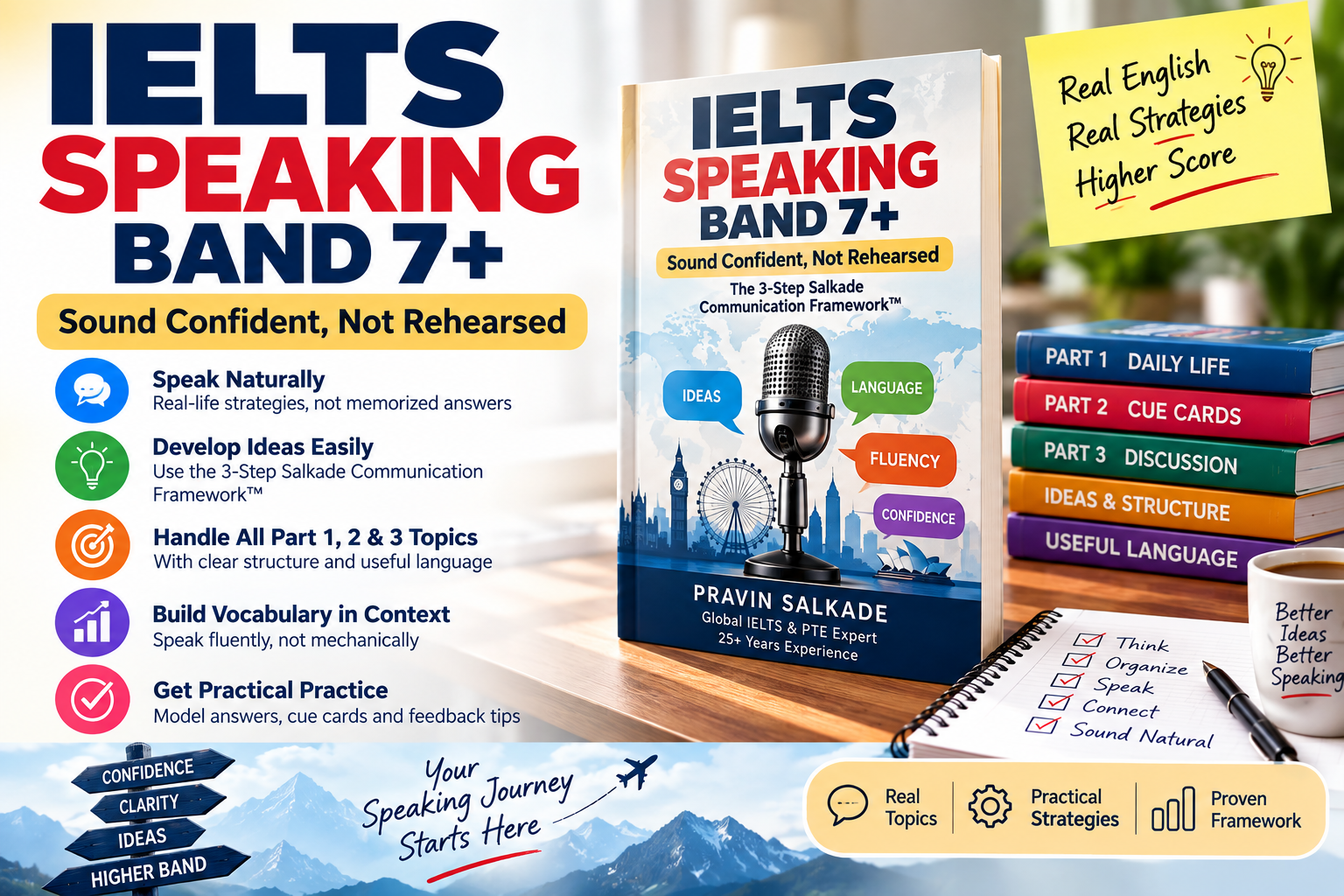
That is the central idea behind IELTS Speaking Band 7+: Sound Confident, Not Rehearsed.
Should I memorize IELTS Speaking answers?
It is better not to memorize complete answers word for word.
Memorization can create several problems:
Your answer may sound rehearsed.
You may forget the next sentence.
You may struggle when the question changes.
Your answer may become less relevant.
You may focus on remembering language instead of communicating.
Instead, prepare ideas, structures, vocabulary, and examples that you can adapt to different questions.
The goal is simple:
Prepare your thinking, not a speech.
What does “Sound Confident, Not Rehearsed” mean?
It means your English should sound like genuine communication rather than a speech learned for an examination.
For example, instead of memorising a perfect paragraph about your hometown, develop several useful ideas:
what your hometown is like,
what you enjoy about it,
what has changed,
a memorable experience,
what you would improve.
You can then combine these ideas according to the actual question.
This makes your response more flexible and natural.
How can I develop ideas quickly in IELTS Speaking?
Many candidates know enough English but struggle because they cannot think of ideas quickly.
A useful solution is to give your answer a simple internal structure.
Think:
Idea → Explanation → Example → Connection
First state your idea.
Then explain why.
Add a specific example or experience.
Finally, connect it back to the question.
This gives you something meaningful to say without memorising a complete answer.
How can I answer IELTS Speaking Part 1 questions better?
Part 1 questions are usually about familiar topics such as
home,
studies,
work,
hobbies,
food,
travel,
daily routines,
friends and family.
You do not need a long speech.
A useful answer often contains:
Direct answer + reason + small detail
For example, if asked whether you enjoy reading, don't simply say:
Yes, I do.
Add a reason and a relevant detail.
The objective is to demonstrate that you can communicate naturally, not that you can produce a memorized essay.
How should I handle IELTS Speaking Part 2 cue cards?
Part 2 can be challenging because you have to speak for an extended period.
Instead of trying to memorize possible answers for hundreds of cue cards, learn how to organize ideas quickly.
A cue card can often be broken into:
Who/What → When/Where → What happened → Why it mattered
Once you have a structure, you can develop the story naturally.
The focus should be on keeping the communication moving, rather than searching for a perfect sentence every few seconds.
What should I do if I cannot think of an idea?
You don't need the most interesting answer.
You need an answer you can explain.
If a question asks about a person, place, activity, or experience, choose something simple that you can describe comfortably.
A familiar personal example is often more useful than an impressive idea that you cannot develop.
Remember:
A simple idea and good development is better than a complicated idea and poor development.
How can I improve IELTS Speaking vocabulary?
Don't focus only on learning long or unusual words.
Learn vocabulary in context.
For example, instead of memorizing the word “beneficial” by itself, learn useful combinations such as
highly beneficial,
beneficial for students,
beneficial in the long run.
Also learn expressions that help you organize ideas:
One reason is...
What I particularly like is...
For example...
From my experience...
Having said that...
The main reason is...
Useful language should help you communicate your ideas, not decorate your answer.
How important is fluency for Band 7?
Fluency is not simply speaking very fast.
A fluent speaker can develop ideas without excessive hesitation while maintaining a natural flow.
Speaking too quickly can actually reduce clarity.
Instead, aim for:
Think → organize → speak → connect
Some natural hesitation is normal. The goal is to avoid long, disruptive pauses and repeatedly restarting sentences.
Can I correct myself during the IELTS Speaking test?
Yes, natural self-correction can occur in communication.
For example:
“I went there last year—actually, it was two years ago.”
That can sound natural.
The important thing is not to become so focused on correcting every small mistake that your communication breaks down.
Your priority should be clear and meaningful communication.
How can I sound more confident in IELTS Speaking?
Confidence comes partly from preparation, but preparation should focus on skills rather than scripts.
Practice:
expanding short answers,
giving reasons,
explaining opinions,
providing examples,
comparing ideas,
telling short stories,
describing experiences,
expressing uncertainty,
agreeing and disagreeing naturally.
When you know how to develop an answer, unexpected questions become easier to handle.
What is the 3-Step Salkade Communication Framework™?
The book introduces the 3-Step Salkade Communication Framework™ as a practical way to approach IELTS Speaking.
The framework focuses on developing the communication process rather than memorising fixed answers.
The broader principle is
Have an idea → develop the idea → communicate it naturally.
This helps learners move from isolated sentences to connected speech.
What is the biggest mistake IELTS Speaking candidates make?
One major problem is preparing for the examiner's question rather than preparing to communicate.
Students often ask:
“What is the perfect answer to this question?”
A more useful question is
“How can I develop my answer if the examiner asks me this?”
That small change in thinking makes preparation much more flexible.
How should I practice IELTS? Speaking every day?
You don't need to spend hours giving complete mock tests.
Try a focused practice cycle:
Step 1: Choose one topic.
For example, travel, technology, or education.
Step 2: Ask yourself five questions.
Answer each one aloud.
Step 3: Expand your answers.
Add a reason, explanation, or example.
Step 4: Record yourself.
Listen for pauses, repetition, grammar problems, and unclear pronunciation.
Step 5: Repeat naturally.
Don't memorize the recording. Try the same topic again using different words.
This develops flexibility.
Who can benefit from IELTS Speaking Band 7+: Sound Confident, Not Rehearsed?
The book is particularly useful for learners who:
memorize answers but struggle with unexpected questions,
know English but cannot develop ideas,
give very short answers,
repeat the same vocabulary,
struggle with Part 2 cue cards,
want to sound more natural,
need a practical speaking framework,
or want to move beyond scripted IELTS preparation.
What is the central lesson of the book?
A strong IELTS speaking candidate does not need to sound like a textbook.
You need to sound like a person who can communicate clearly in English.
Build ideas.
Develop them.
Connect them.
Speak naturally.
Don't prepare a performance. Prepare yourself to communicate.
That is the thinking behind IELTS Speaking Band 7+: Sound Confident, Not Rehearsed by Pravin Salkade.