Negotiate Anything Without Getting Emotional
Q1. Why do people become emotional during negotiations?
People become emotional in negotiations because they often feel that something important is being threatened—money, status, respect, control, recognition, or fairness.
A simple disagreement can quickly become personal:
They rejected my offer. → They don't respect me.
They questioned my price. → They don't value my work.
They refused my request → They are taking advantage of me.
Once we interpret negotiation as a personal battle, our emotions begin making decisions for us.
The better approach is to separate the person from the problem.
A negotiation is not necessarily a conflict. It is a process of finding an arrangement that both sides can accept.
Key lesson: Don't negotiate your emotions. Negotiate the situation.
Q2. What does “Don’t react. "Negotiate" actually means?
It means that you should not immediately respond to pressure, criticism, anger, or an unreasonable demand.
Instead, pause and ask:
What is the other person really trying to achieve?
For example, suppose someone says:
Your price is too high. Give me a 30% discount.
A reactive response might be:
Fine, I'll reduce it.
Another reactive response might be:
Then don't buy it.
A negotiating response would be:
What budget were you working with, and what part of the current offer would you be willing to adjust?
The third response keeps the conversation open without surrendering your position.
Q3. How can I negotiate without becoming emotional?
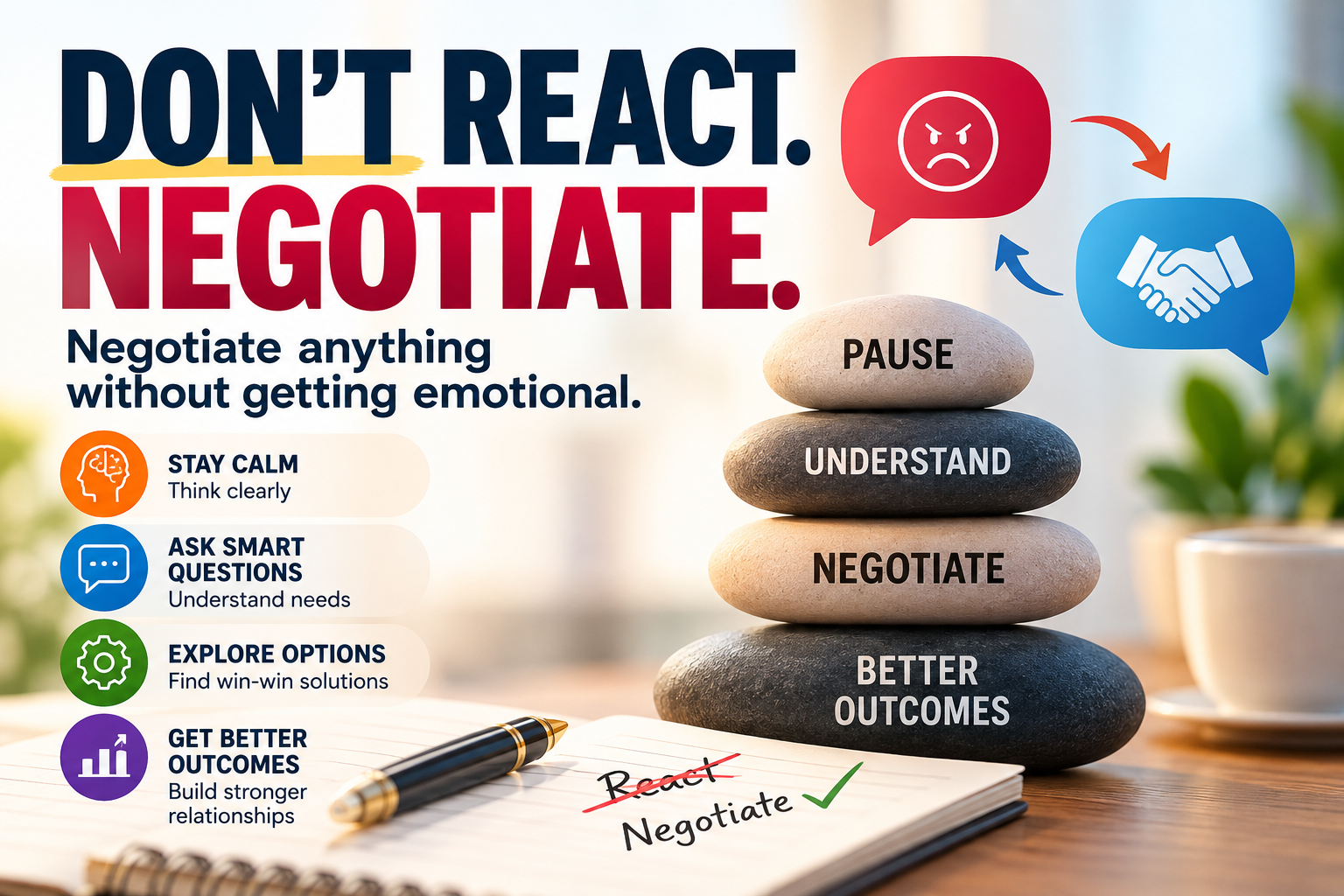
Use the PAUSE method:
P – Pause before responding
Don't answer immediately when you feel provoked.
A – Assess the situation
What exactly has been said or requested?
U – Understand the other side
What does the other person actually want?
S – Separate facts from emotions
Don't confuse disrespect with disagreement.
E – Engage strategically
Respond to the issue, not to the emotion.
This simple process creates a gap between what happens and how you respond.
That gap is where negotiation power exists.
Q4. What should I do when someone becomes aggressive during negotiation?
Don't automatically match their aggression.
Lower your emotional intensity instead.
You can say:
I understand that this is important to you. Let's look at what would work for both of us.
This does three things:
It acknowledges the person's concern.
It avoids unnecessary confrontation.
It brings the conversation back to the problem.
Remember:
Someone else's emotional intensity does not have to become your emotional intensity.
Calmness is not weakness. In many negotiations, calmness is leverage.
Q5. Should I respond immediately when someone gives me an ultimatum?
Not necessarily.
An ultimatum often creates artificial urgency:
Take it or leave it.
Instead of reacting, investigate.
Ask:
Is that your final position, or is there another way we can structure the agreement?
You may discover that the apparent “final offer” was simply an attempt to create pressure.
The person who controls the pace of the conversation can sometimes control the quality of the decision.
Never let someone else's urgency become your emergency.
Q6. How can silence help during negotiation?
Silence can be extremely powerful.
People often become uncomfortable when there is a pause after an offer.
They may start explaining themselves, revealing information, or improving their proposal.
For example:
I'll give you ₹80,000. That's my final offer.
Instead of immediately saying yes or no, pause.
You don't have to fill every silence.
Silence gives you time to think and prevents emotional concessions.
But silence should not be used as a manipulative trick. Its real purpose is to create space for thoughtful decision-making.
Q7. How do I negotiate when I feel insulted?
First, ask yourself:
Was I actually insulted, or did I interpret disagreement as disrespect?
This distinction matters.
Suppose a client says:
Your fee is too high for this service.
That statement challenges your price—not necessarily your intelligence, ability, or worth.
A useful response is:
What specifically makes you feel the price is too high?
Now you have moved from emotion → information.
And information is much more useful in negotiation than anger.
Q8. How can I negotiate a better price without sounding difficult?
Don't focus only on demanding a lower price.
Explore value, scope, timing, quantity, and terms.
For example:
If the full package is outside my budget, can we reduce the scope and keep the essential components?
This creates another option instead of creating a confrontation.
Good negotiators don't simply ask:
Can you reduce the price?
They ask:
What can we change to make the agreement work?
Q9. What should I never say when I am angry during a negotiation?
Avoid statements that permanently damage the relationship:
Forget it.
Do whatever you want.
You are impossible.
I don't need your business.
Take it or leave it.
You clearly don't understand anything.
These statements may feel satisfying for five seconds.
But negotiation is about consequences, not temporary emotional satisfaction.
Before saying something irreversible, ask:
Will this sentence improve my position tomorrow?
If not, don't say it today.
Q10. What is the biggest mistake people make in negotiation?
The biggest mistake is confusing winning the argument with getting the desired outcome.
You can prove that you are right and still lose the negotiation.
You can defeat someone's argument and lose the customer.
You can win the confrontation and lose the relationship.
You can get the last word and still get the worst deal.
Effective negotiation asks a different question:
What outcome do I actually want?
Once you know the desired outcome, you can choose your response strategically.
Q11. How can I negotiate when the other person knows I need the deal?
Don't reveal desperation unnecessarily.
If you desperately need the agreement, you may accept conditions that you would normally reject.
Instead, identify your:
Ideal outcome
Acceptable outcome
Minimum acceptable outcome
Walk-away point
This gives you a framework before emotions enter the conversation.
Preparation reduces emotional decision-making.
The strongest negotiator is not always the person with the most power. Sometimes it is the person who is most prepared to walk away.
Q12. How can I negotiate in salary discussions?
Don't make the conversation only about salary.
Consider negotiating:
Salary
Role
Responsibilities
Performance incentives
Working hours
Location
Leave
Training
Review timelines
Benefits
Instead of saying:
I deserve a higher salary.
Try:
Based on the responsibilities of the role and the value I expect to contribute, could we discuss whether there is flexibility in the compensation package?
The second approach is less emotional and more evidence-based.
Q13. How should I respond when someone says, “Everyone else is charging less”?
Don't immediately defend yourself.
Ask:
What specifically are you comparing?
Price comparisons are meaningful only when the products, services, quality, experience, scope, and outcomes are comparable.
A useful response might be:
I understand. If price is the primary consideration, we can explore a simpler option. If the objective is a particular outcome, let's compare what is included in each offer.
You have now shifted the discussion from price to value.
Q14. Can empathy make me a better negotiator?
Yes.
Empathy doesn't mean agreeing with the other person.
It means understanding their perspective.
Ask:
What are they worried about?
What do they need?
What would make them feel that the agreement is fair?
When you understand the other person's priorities, you can often create solutions that were invisible at the beginning.
The goal is not to manipulate the other person.
The goal is to understand the real problem well enough to solve it.
Q15. What is the difference between reacting and negotiating?
Reacting asks:
How do I respond to what they just said?
Negotiating asks:
What outcome do I want, and what is the best way to reach it?
Reacting is immediate.
Negotiating is deliberate.
Reacting focuses on the last statement.
Negotiating focuses on the final outcome.
Reacting is driven by emotion.
Negotiating is guided by strategy.
That difference can transform difficult conversations.
The DON’T REACT. NEGOTIATE. Principle
When someone pressures you, criticises you, rejects your proposal, or makes an unreasonable demand, remember:
Pause.
Ask questions.
Understand interests.
Separate people from problems.
Explore alternatives.
Know your limits.
Protect the relationship when it matters.
And most importantly:
Don't make a permanent decision to satisfy a temporary emotion.
Negotiation is not about becoming emotionless.
It is about becoming emotionally disciplined.
You can feel angry without responding angrily.
You can feel disappointed without giving up.
You can feel pressured without surrendering.
You can disagree without attacking.
And you can be firm without becoming aggressive.
The ultimate negotiation skill is simple:
Control your reaction before you try to influence the outcome.
That is why the principle is:
DON'T REACT. NEGOTIATE.