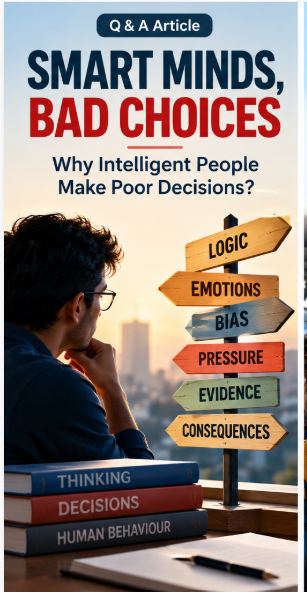
Being intelligent does not automatically make someone a good decision-maker.
A person can have excellent academic qualifications, strong analytical skills and years of experience—and still make a decision that they later regret.
Why?
Because intelligence helps us solve problems, but it does not always protect us from the thinking errors that create those problems.
What is the biggest reason smart people make bad choices?
One major reason is that intelligent people can become very good at justifying their decisions.
Instead of asking:
“Am I making the right decision?”
They may unconsciously ask:
“How can I prove that my decision is right?”
This subtle difference can completely change the outcome.
A smart person may collect evidence supporting a preferred decision while ignoring evidence that challenges it.
That is not a lack of intelligence.
It is a failure of judgement.
Does intelligence protect us from cognitive biases?
No.
In fact, intelligence can sometimes make certain biases more difficult to detect.
A clever person can construct sophisticated explanations for a poor decision.
For example:
“I know the risks, but this situation is different.”
“I have researched this extensively.”
“I have more experience than most people.”
These statements may sound rational.
But sometimes they are simply better arguments defending a bad decision.
Why do people make decisions based on incomplete information?
Because waiting for perfect information can be impossible.
We make decisions about careers, relationships, investments, education, business and everyday life without knowing everything.
The solution is not to eliminate uncertainty.
The better approach is to recognise uncertainty and ask:
“What am I assuming?”
That single question can expose weaknesses that intelligence alone may miss.
How can intelligent people make better decisions?
They can separate confidence from correctness.
Before making an important decision, ask:
What do I know?
What am I assuming?
What evidence could prove me wrong?
What is the strongest argument against my choice?
What happens if I am wrong?
The goal is not to become less confident.
It is to become more intellectually honest.
What is the central lesson of Smart Minds, Bad Choices?
The most dangerous decision-maker is not necessarily an unintelligent person.
It can be an intelligent person who has become too confident in their own explanation.
Good decisions require more than intelligence.
They require curiosity, humility, evidence and the willingness to question your own thinking.
A smart mind can find an answer.
A wise mind first asks whether it is asking the right question.
That is the deeper lesson behind Smart Minds, Bad Choices.