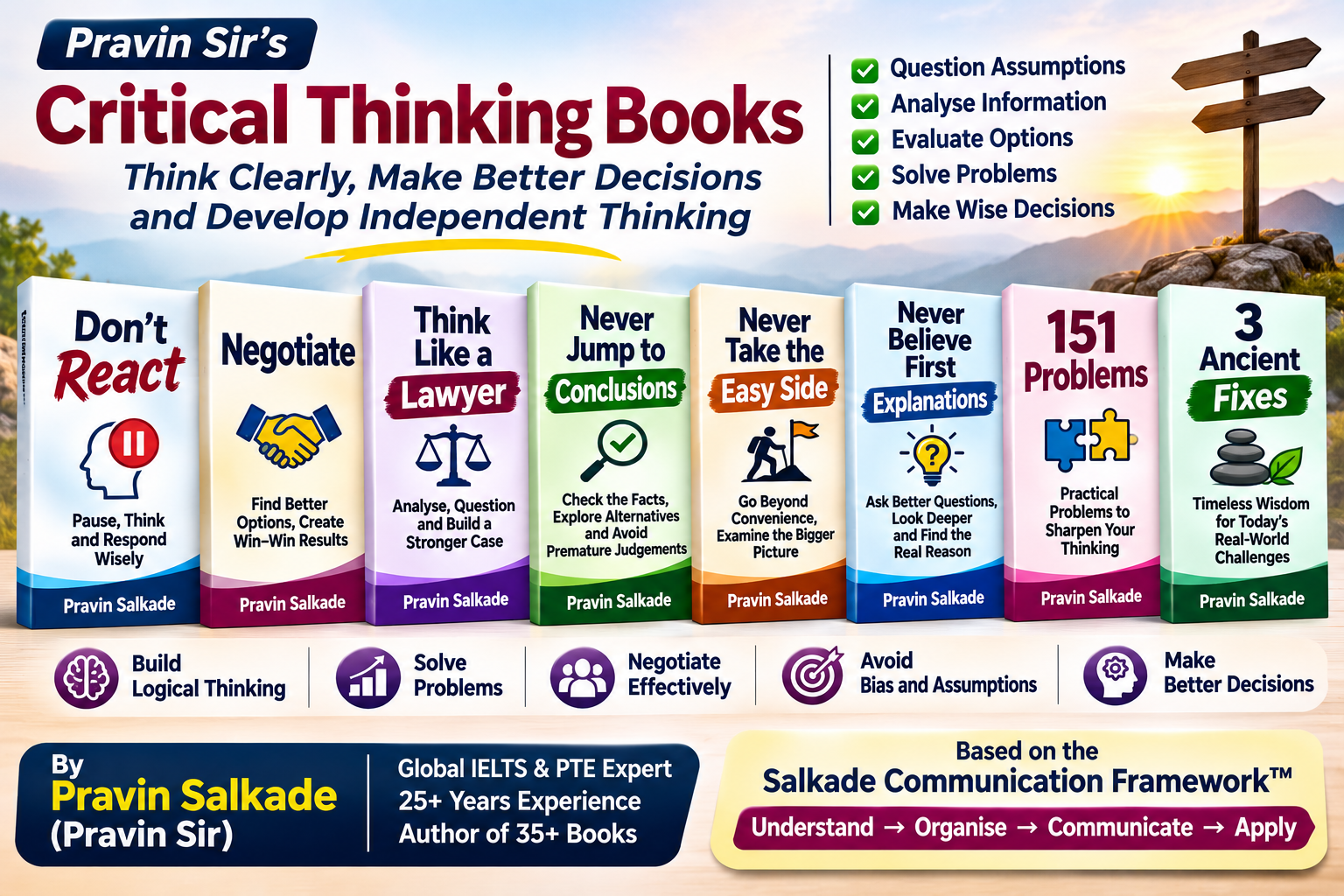
When faced with a difficult question, most people instinctively look for the easiest explanation.
It feels comfortable.
It reduces uncertainty.
And it saves mental effort.
But the easiest explanation is not necessarily the correct one.
That is why one powerful intellectual habit is:
Never Take the Easy Side.
What does Never Take the Easy Side mean?
It does not mean deliberately choosing the difficult answer.
It means refusing to accept an explanation simply because it is convenient, popular or emotionally satisfying.
Suppose a student performs poorly in an examination.
The easy explanation might be:
“They are not intelligent.”
But is that necessarily true?
Perhaps they did not understand the question.
Perhaps they used an ineffective study method.
Perhaps they misunderstood the marking criteria.
Perhaps anxiety affected their performance.
The easy explanation may be attractive.
The real explanation may require investigation.
Why do people prefer easy explanations?
Because the human brain wants efficiency.
A simple explanation gives us a quick sense of certainty.
This can be useful in everyday life.
But it becomes dangerous when the decision has important consequences.
We may judge:
a student
an employee
a business
a relationship
a political event
an investment
a failure
without understanding the complete situation.
How can you avoid jumping to the easiest conclusion?
Ask one powerful question:
“What else could explain this?”
Then generate at least three possible explanations.
For example:
Sales have fallen.
Instead of immediately concluding:
“The market is bad.”
Ask:
Could the pricing be wrong?
Could competitors have changed their strategy?
Could customer behaviour have changed?
Could the product have become less relevant?
Could the marketing message be weak?
This simple exercise creates intellectual distance between observation and conclusion.
Does questioning the easy answer make decision-making slower?
Sometimes.
But slower does not necessarily mean worse.
A few additional minutes of thinking can prevent months of dealing with the consequences of a poor decision.
The goal is not to overanalyse everything.
The goal is to slow down when the cost of being wrong is high.
What is the difference between an easy answer and a strong answer?
An easy answer explains the situation quickly.
A strong answer survives questioning.
That is the difference.
If an explanation collapses when you ask:
“What evidence supports this?”
“What evidence contradicts it?”
“What else could explain it?”
Then perhaps it was never a strong explanation.
What is the central lesson of Never Take the Easy Side?
The first explanation is only a hypothesis.
The popular explanation is only a hypothesis.
Even your own explanation is only a hypothesis.
Good thinking begins when you are willing to challenge it.
Don't ask only, “What is the easiest explanation?”
Ask, “What explanation remains after I question the easy one?”
That is where better thinking begins.