When something goes wrong, we naturally want an explanation.
Why did the student fail?
Why did the business lose customers?
Why did the relationship change?
Why did the investment fall?
Why did someone behave differently?
The brain often wants a quick answer.
And once we find one, we feel satisfied.
But there is a problem:
The first explanation is often only a hypothesis—not the truth.
Why do people believe the first explanation?
Because uncertainty is uncomfortable.
An explanation gives us a feeling of closure.
Suppose a student gets a low score.
The first explanation might be:
“The student is weak in English.”
It sounds reasonable.
But perhaps the real problem is poor time management.
Or unfamiliarity with the test format.
Or misunderstanding the question.
Or anxiety.
Or ineffective preparation.
The first explanation may be possible without being correct.
What is the danger of accepting the first explanation?
It can cause us to solve the wrong problem.
If we assume that a student lacks vocabulary, we may give them hundreds of new words.
But if the real problem is that they cannot identify the main idea of a passage, more vocabulary may not solve anything.
A wrong diagnosis can produce a perfectly executed wrong solution.
That is why good thinking begins with diagnosis.
How can you avoid jumping to conclusions?
Ask:
“What else could explain this?”
Then deliberately search for alternative explanations.
A useful three-question test is:
What is my first explanation?
What evidence supports it?
What other explanation could also fit the evidence?
The third question is particularly powerful.
It forces the mind to move beyond its first story.
Does questioning the first explanation mean we should distrust everything?
No.
The objective is not permanent doubt.
It is intellectual discipline.
A reasonable explanation can become stronger when it survives questioning.
You are not rejecting the first explanation.
You are testing it.
Why is this important for students?
Students frequently confuse an outcome with its cause.
A low IELTS score does not automatically mean poor English.
A wrong PTE answer does not automatically mean insufficient vocabulary.
A low academic grade does not automatically mean lack of intelligence.
The visible result is only the starting point.
The important question is:
“What actually caused it?”
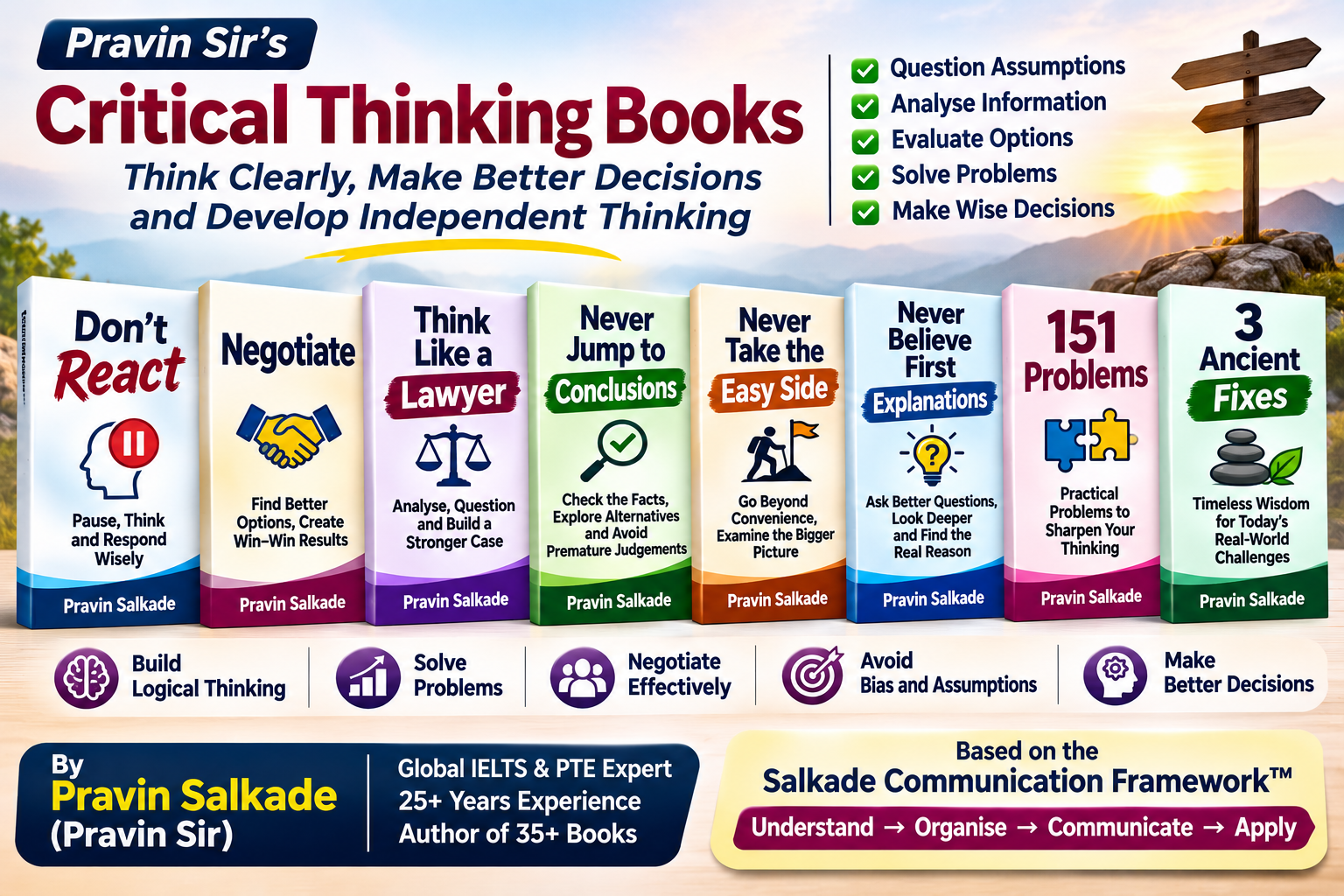
What is the deeper lesson of Never Believe the First Explanation?
The first explanation is attractive because it is available.
The second explanation requires thinking.
The third may require investigation.
And sometimes the correct explanation is the one we did not initially consider.
Don't fall in love with your first explanation.
Test it. Challenge it. Replace it if the evidence demands it.
Better thinking begins when certainty is replaced by curiosity.